
What Puro actually sells
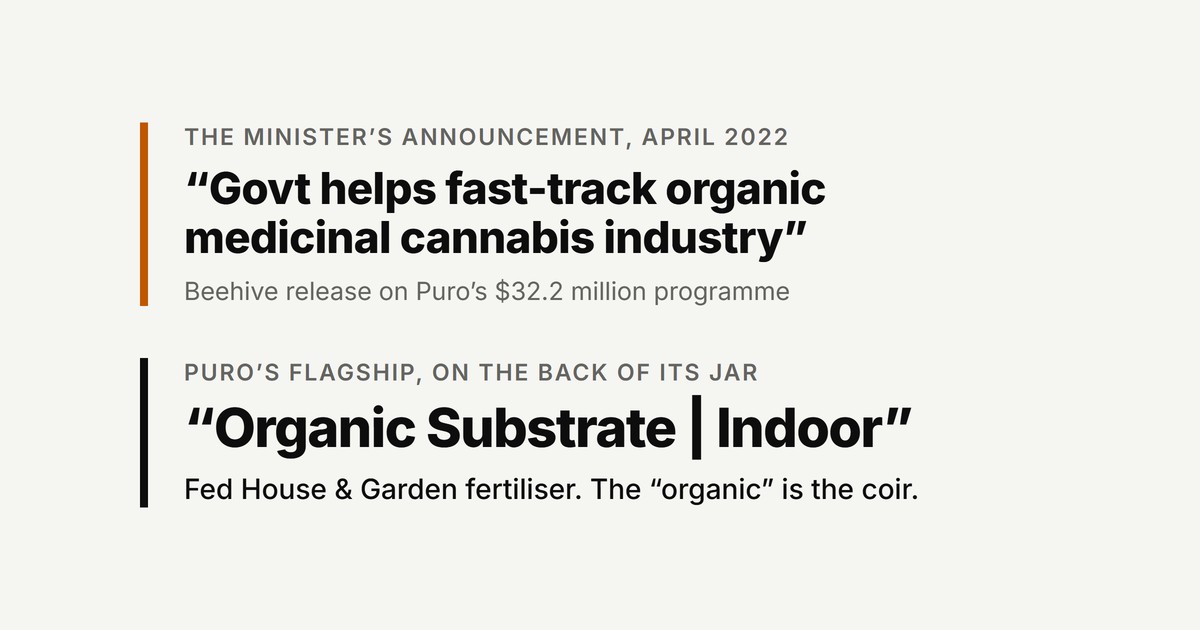
Here's a riddle. When does certified organic cannabis stop being organic? When it's been gamma irradiated. Hold that thought.
In April 2022, the Government announced a $32.2 million joint project with Puro, New Zealand's biggest medicinal cannabis grower. The Ministry for Primary Industries (MPI) put in $13 million through its Sustainable Food and Fibre Futures (SFF Futures) fund, and Puro funded the rest. Organic was right there in the headline of then-Agriculture Minister Damien O'Connor's release, "Govt helps fast-track organic medicinal cannabis industry". He said the money was to help Puro "fast-track the establishment of an organic medical cannabis industry in New Zealand".
Puro has stuck with that line. Its COO, Winston Macfarlane, told Marlborough Now in November 2025 that "natural medicine should be organic".
I've already written about the handbook, the glasshouse and the 200 jobs, and last week about who's paying to run Puro. On the handbook, a recent Instagram post from Puro mentions a "forthcoming 'Organic Cannabis Growers Guide'", which sounds like the same thing under a new name. MPI's latest advice is still to expect it at the end of 2027.
This post is about something simpler. What does Puro actually sell, and does it match that pitch?
Some of it does. Puro's Kēkerengū farm is organically certified, and I'm not disputing that. But its flagship flower, Kākāriki Koha, the one cultivar its FAQ ties to the grant, is grown indoors with House & Garden fertiliser and hang dried. Yet the back of its jar says "Organic Substrate | Indoor". And Puro's own annual report raises questions about the organic flower it sends overseas.
Usual disclosure applies: I help people get licensed to cultivate, I've freely shared my own SOPs, and through Pause Labs / Chill Division I've got NZ-grown flower of my own on the market here in Aotearoa New Zealand. I'm not a neutral party, which is exactly why everything below is quoted with source references for you to check.
The short version
- Puro New Zealand sells itself on certified organic, sun-grown medicinal cannabis, and its outdoor farm at Kēkerengū is certified organic.
- Its flagship flower, Kākāriki Koha ("Green Gift"), is grown indoors at Puro's Waihopai facility with House & Garden and Plant Mechanics fertiliser solutions, then hang dried. That's from Puro's own product sheet.
- The back of the Kākāriki Koha jar says "Organic Substrate | Indoor". Puro co-founder Tom Forrest said "organic substrate" means "an organic media, with coir, diatomaceous earth and other natural substrate ingredients". Puro's own FAQ says organic certification means growing "without synthetic chemicals and fertilisers".
- The NZ Herald and AusCannaReviews both described Kākāriki Koha as New Zealand-certified organic. Puro's own pages never say that outright, however Puro doesn't appear to have tried to correct those statements. Quite the opposite as we look at later on.
- In the UK, MedBud lists all the Puro flowers I could find as bulk-imported raw material that's gamma irradiated, with an About Puro panel saying "we grow organic cannabis". Organic certification doesn't allow irradiation.
What Puro tells its shareholders
Puro's annual report to shareholders for the year to June 2026 opens its directors' report like this. "What sets Puro apart is how we grow: certified organic, pesticide-free and under the New Zealand sun." Two pages later it says New Zealand's sun, air and soils "create growing conditions that indoor growing cannot replicate".
The same report says Waihopai "continues to lead our breeding programme and indoor flower production", and that Puro has "a standing order for our Kakariki Koha flower product from Waihopai".
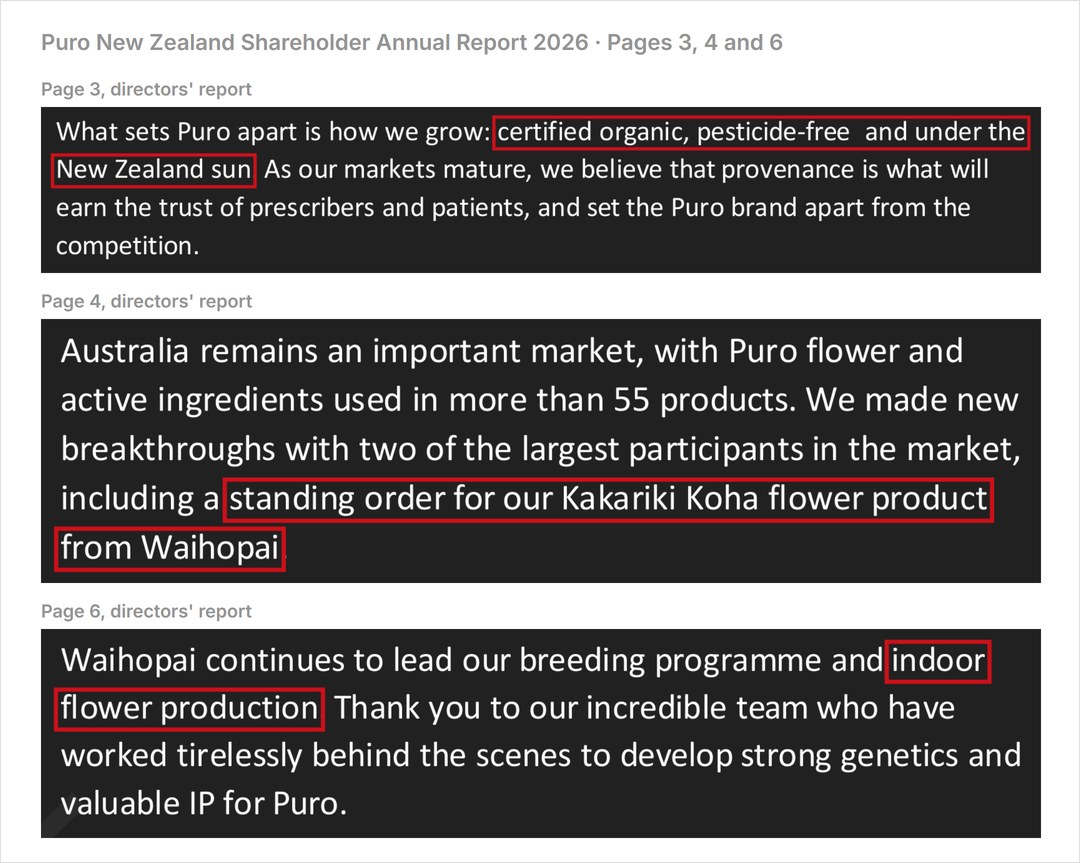 Puro's annual report to shareholders, 2026, pages 3, 4 and 6
Put those two lines together and Kākāriki Koha comes from Waihopai, not the certified farm. But after an opening like that, would a shareholder ever put them together? Or do they too just think everything Puro sells is certified organic?
So what's coming out of Waihopai?
The flagship
Puro sells a range of flower, but its flagship is a flower called Kākāriki Koha, sold in Australia through Heyday Medical. It's the one cultivar Puro's FAQ names when it describes the grant, under "genetics development (including our flagship Kākariki Koha cultivar)". The NZ Herald reported in November 2024 that Puro's chief executive, Sank Macfarlane, said it "was possible thanks to" the grant.
Here's how Puro's own product sheet says it's grown and packed.
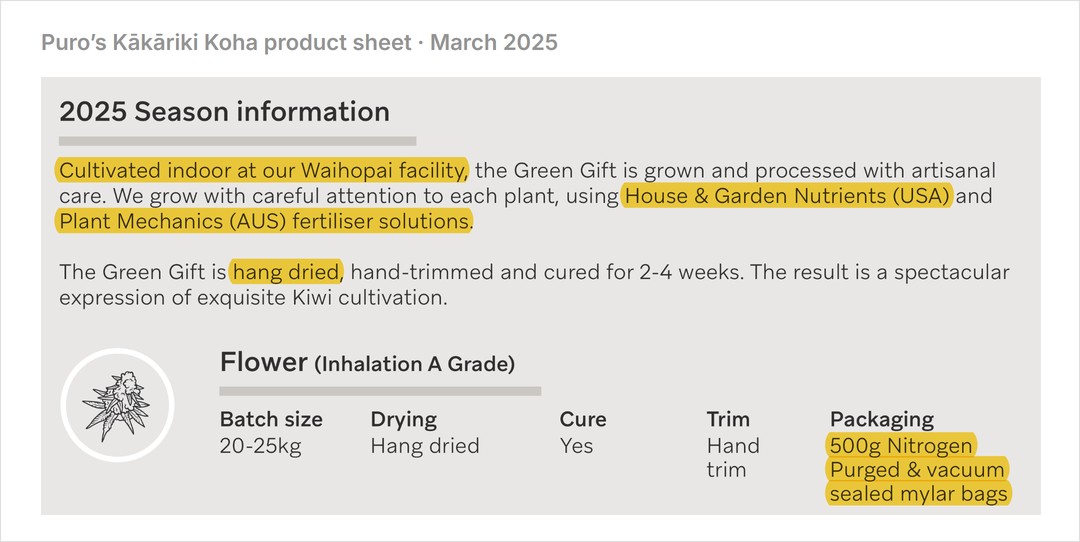 Puro's Kākāriki Koha product sheet, March 2025
So the flagship cultivar, from a programme sold on organic cannabis, is grown indoors at Waihopai, with fertiliser solutions from House & Garden and Plant Mechanics. It's not just an old PDF either. Puro's products page still describes it as "Grown indoors with artisanal care". The word organic isn't on either page of the sheet. The jar's another story, and I'll get to that. Puro's FAQ says "Everything we grow at our Kekerengu farm is organically certified", and calls Waihopai its "indoor research and breeding facility". The same FAQ says outdoor growing creates profiles that are "impossible to replicate under artificial lighting".
That FAQ also says what organic certification means at Kēkerengū. "This means we grow without synthetic chemicals and fertilisers." House & Garden's base feeds aren't that kind of input. One US retailer describes its Cocos A base nutrient as "an inorganic-based liquid nutrient and is not OMRI certified".
Granted, growing indoors was always part of this programme, which has a workstream called "Indoor Cultivation Systems". And a sheet that doesn't say organic doesn't prove a crop isn't organic. But if you ask me, a certified organic flagship would say so on its own product sheet, and a flower fed on inorganic base nutrients doesn't meet Puro's own definition.
There's another thing about those two brands. Puro's co-founder and chief development officer, Tom Forrest, works in sales for a wholesaler that sells them. On the AusCannaPodcast in April 2025, he said he works with "a leading importer", Stealth Garden Wholesale, and that "we represent brands like House and Garden nutrients and Plant Mechanics". He called it "a little spruik for what I do professionally".
His speaker profile for Cannabis Europa London 2026 says he "works as Commercial Sales Manager and Technical Support for Stealth Garden Wholesale". Stealth Garden's site listed him on its team from at least 2017, and its about page said it wholesaled to over 200 stores "across Australia and New Zealand". It still lists both brands today.
There's a second company too. Indicated Technology's website calls Tom its "co-founder and Managing Director", and says it "provides agricultural equipment procurement services to licensed cultivators throughout Australia and New Zealand". Its home page lists the brands it's "Distributors of", including House & Garden and Mobius trimming machines. Australian company records show Tom has been a director since it was set up in December 2016, and he's its biggest shareholder, with 194 of its 400 shares. Its only other directors are Stealth Garden's two directors.
Indicated Technology Pty Limited also owns 4.18% of Puro, with 2,388,330 shares. Its address on Puro's share register is 2 Gurners Lane in Lonsdale, South Australia. ASIC's records give the same address for Stealth Garden's business.
Back in that April 2025 podcast, he also said "For us at Puro, it's sourcing inputs as close to farm gate as possible. There's no point buying a Norwegian sea kelp product and calling ourselves sustainable." Then he asked "why am I shipping an IBC of seaweed around the world and then pretending that's better than a bottle of fertilizer?" Puro's flagship is fed with fertiliser from the USA and Australia, from the same two brands he'd plugged earlier in that interview.
I don't know for sure whether Puro buys any of its nutrients or equipment through Stealth Garden or Indicated Technology, or whether Tom earns anything from Puro's orders. I've been told Puro bought a trimming machine and a bunch of extras through one of them, but I haven't seen the invoice myself, so we're going to put it in the unverified basket for now. And House & Garden is a popular brand in its own right. Still, Puro's co-founder sells the flagship's fertiliser brands for one business, and is the biggest shareholder in another that distributes House & Garden. On a taxpayer co-funded programme, that looks like a potential conflict of interest to me, and it needs explaining.
Puro's annual report does list some dealings with its shareholders. Its related party note for the year to June 2026 shows $196,013 for a "Lease of land" under "Shareholders in the Company". Earlier reports say Puro leases its outdoor site at Kēkerengū from Winterhome Trustees, "a shareholder of the Company". Indicated Technology holds more Puro shares than Winterhome does, but it isn't mentioned in any of Puro's last three annual reports. Admittedly, the accounting rules might not require it, because Tom holds just under half of Indicated Technology rather than a majority.
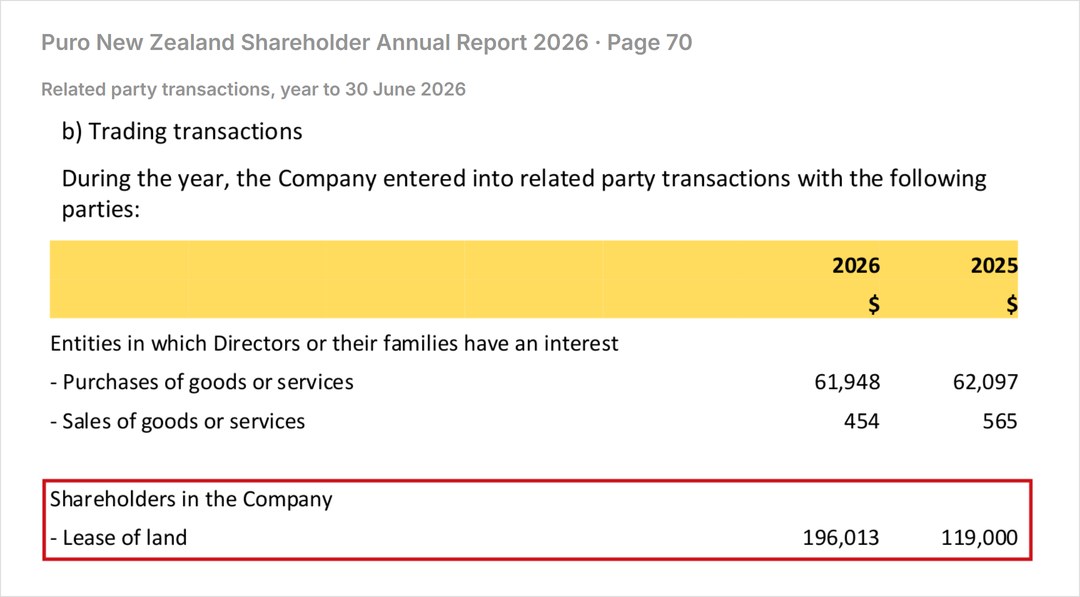 Puro's annual report to shareholders, 2026, page 70
So if Puro did buy that trimmer through Indicated Technology, why would one shareholder's land lease make the note and another shareholder's sale not? Has Puro told shareholders and MPI about Tom's interests? And was any of it claimed as programme cost?
How "organic" stuck to it anyway
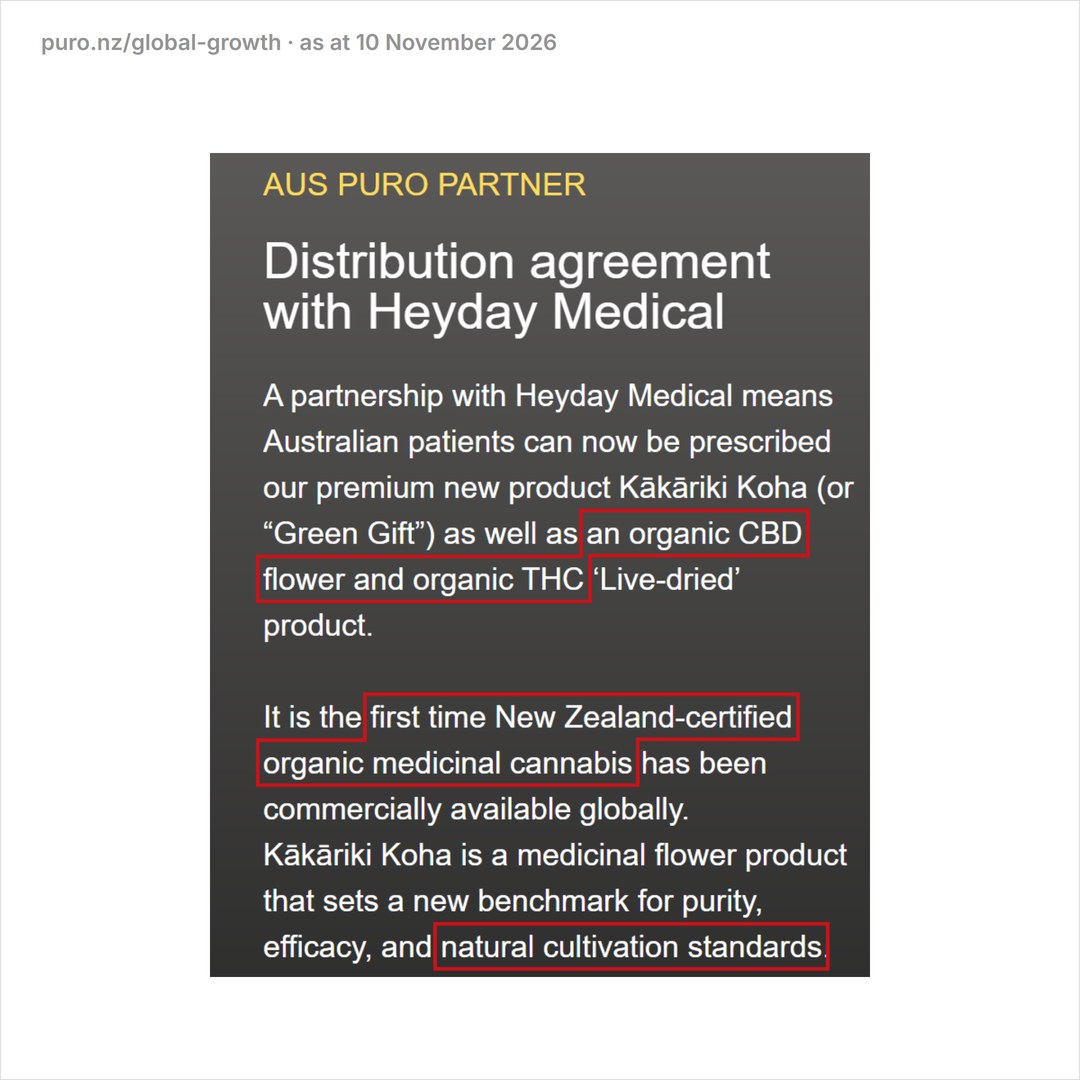
But back to the organic questions at hand. Kākāriki Koha is grown indoors with House & Garden fertiliser, and it doesn't come from the certified farm. That hasn't stopped the word organic sticking to it. Puro's global growth page puts Kākāriki Koha alongside "an organic CBD flower and organic THC 'Live-dried' product", then says "It is the first time New Zealand-certified organic medicinal cannabis has been commercially available globally." It goes on to say Kākāriki Koha "sets a new benchmark for purity, efficacy, and natural cultivation standards".
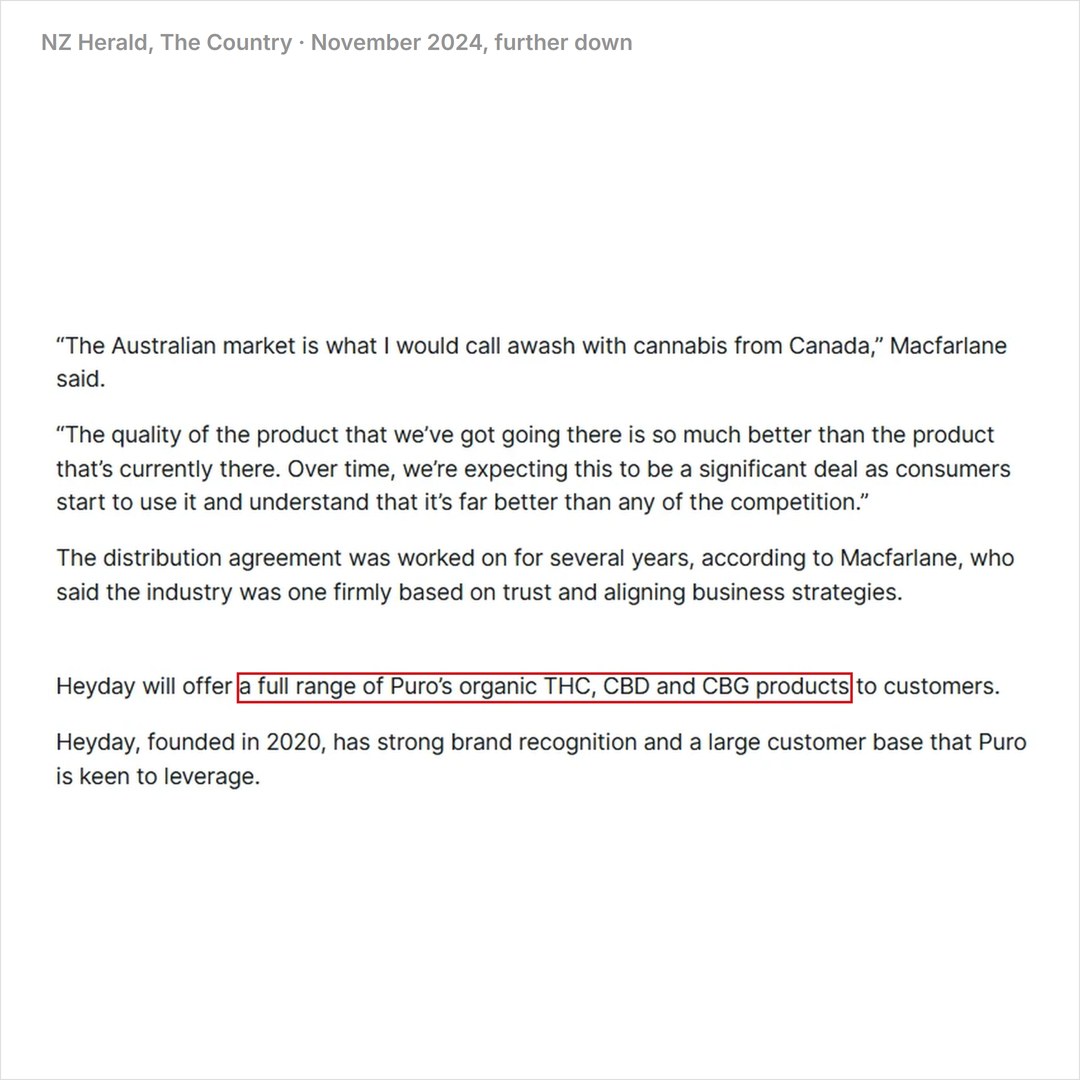
When it launched in Australia in November 2024, Pharmacy Daily's story used the same language. It said Heyday would offer "a full range of Puro's organic THC, CBD, and CBG products, which are cultivated outdoors on a coastal farm and processed using a live-drying technique", and that Kākāriki Koha's products aimed to set "new standards in purity, natural cultivation, and therapeutic potency". Kākāriki Koha isn't grown outdoors, isn't live dried, and doesn't come from the certified farm.
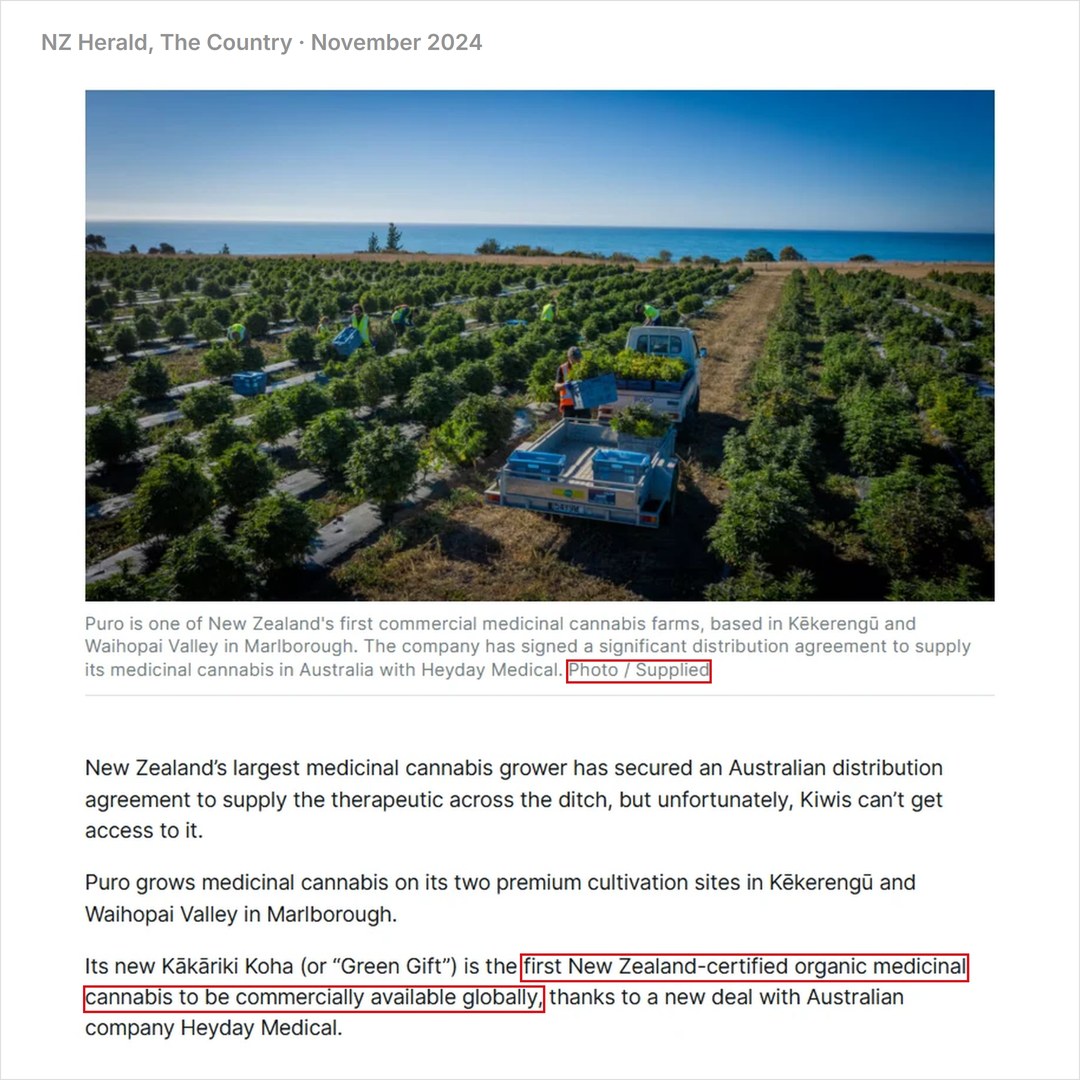
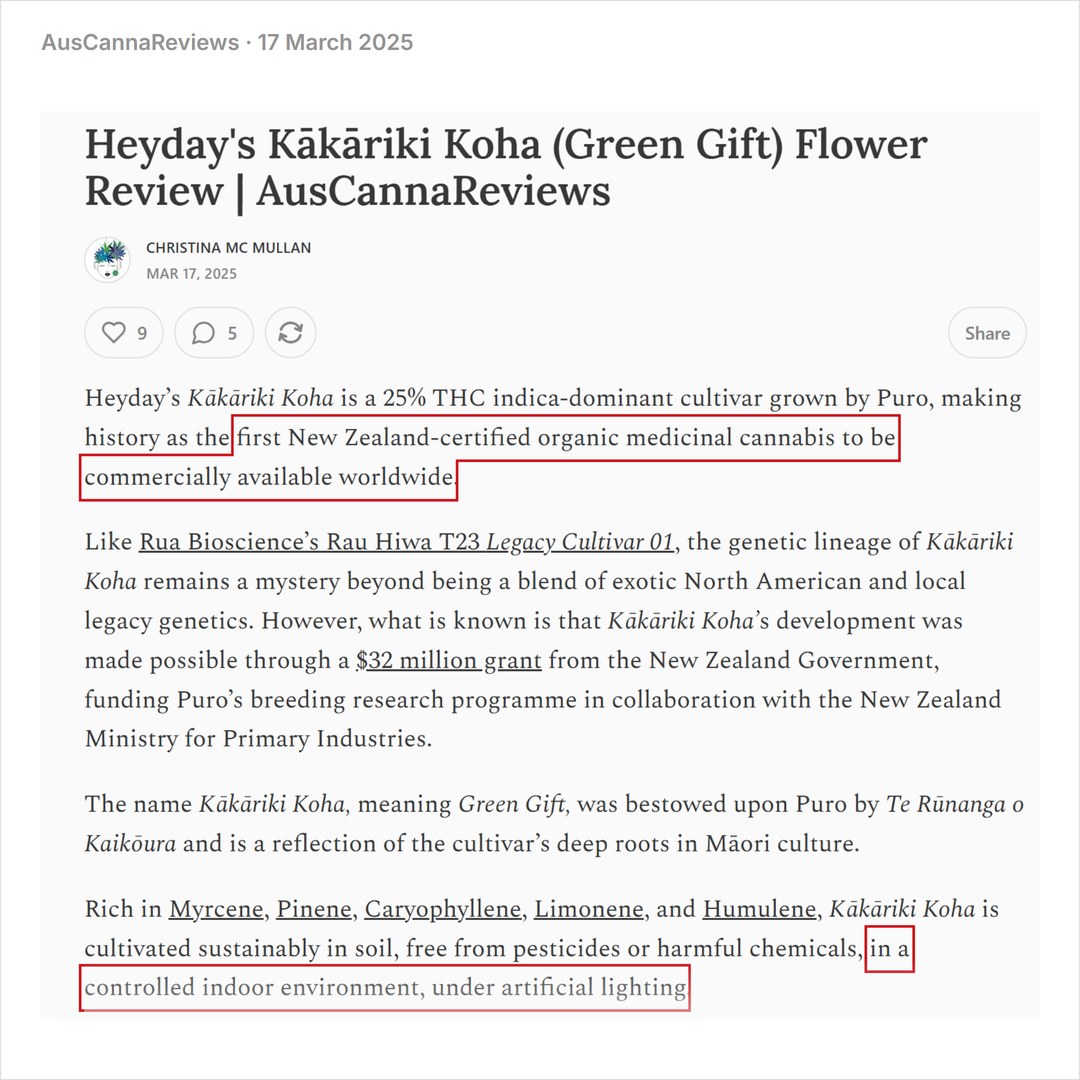
The NZ Herald went further, writing that Kākāriki Koha "is the first New Zealand-certified organic medicinal cannabis to be commercially available globally". That's almost word for word the line on Puro's own page, except the Herald made Kākāriki Koha the subject. The same story said Heyday would offer "a full range of Puro's organic THC, CBD and CBG products", and its lead photo, supplied, was of an outdoor harvest. A reviewer in Australia described Kākāriki Koha as "the first New Zealand-certified organic medicinal cannabis to be commercially available worldwide", in a review that also says it's cultivated "in a controlled indoor environment, under artificial lighting". I couldn't find a correction of either.
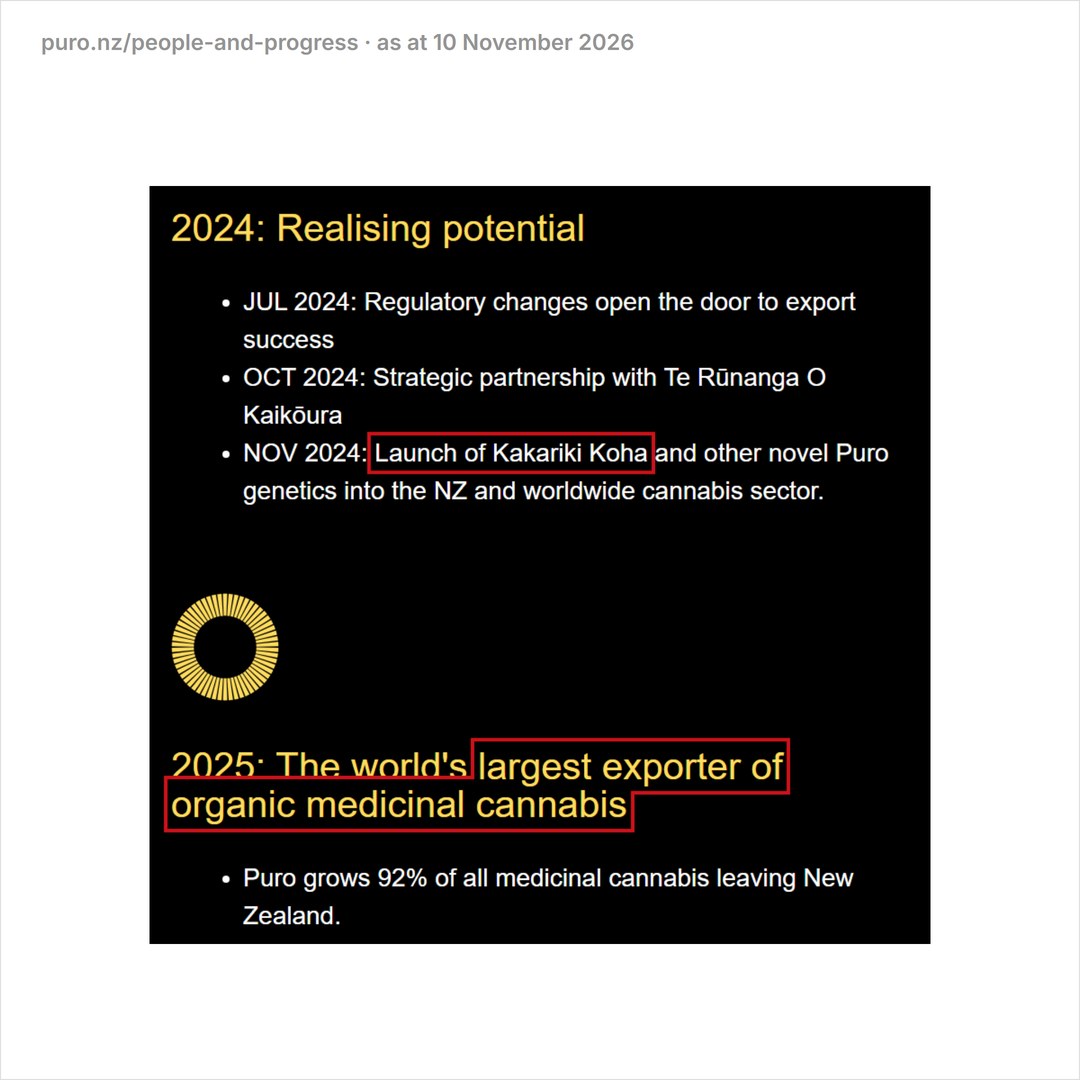
Puro's own site keeps the two close together. Its innovation page goes from ingredients "exactly as they exist in our organic plants" straight into a section on Kākāriki Koha, although it does then say the flower is "Grown indoors with artisanal care". Its timeline lists "NOV 2024: Launch of Kakariki Koha and other novel Puro genetics into the NZ and worldwide cannabis sector", followed by "2025: The world's largest exporter of organic medicinal cannabis".
Puro's annual report to shareholders for 2024 did it too. It said Kākāriki Koha "is produced at our Waihopai facility", then quoted Heyday's chief medical officer, Dr Jim Connell, crediting "Puro's commitment to organic cultivation" for a product that "meets medical-grade expectations", and praising Kākāriki Koha in the next breath.
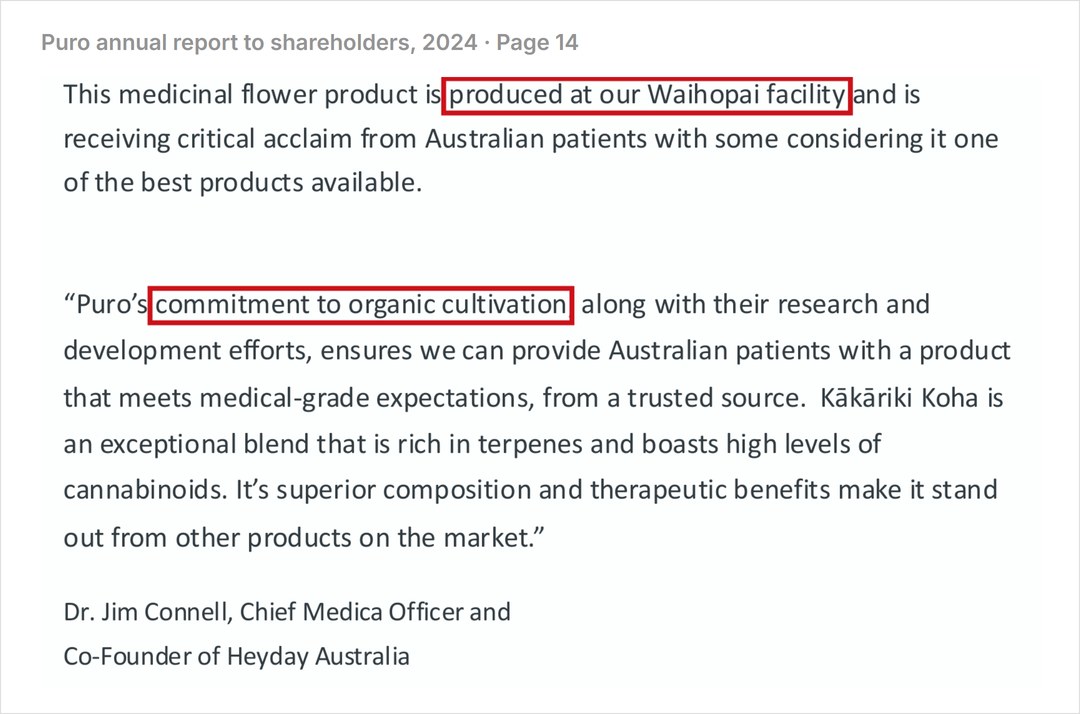 Puro's annual report to shareholders, 2024, page 14
See the pattern? Organic first, then the indoor flagship straight after, and leave the reader to put two and two together. Puro never says outright that Kākāriki Koha is organic, only that the substrate is organic and it's grown indoors. But the Herald and AusCannaReviews both put two and two together in print, and Puro's own pages still use the same wording two years on. If you ask me, that's not an accident. Puro is relying on the misunderstanding.
It's still happening. On 18 November, Puro shared a Newsweed feature on LinkedIn, saying it shines a spotlight on Puro and "our approach to outdoor, sun-grown cultivation". Newsweed, a French cannabis news site, says Puro chose open fields and natural sunlight while much of the industry was building indoor facilities. It mentions Waihopai once, as another cultivation site. It doesn't mention Kākāriki Koha, or that Puro grows anything indoors.
Puro's flower has made it to the UK too, and credit where it's due, that's no small thing for a New Zealand grower. MedBud, a site that tracks the UK's medical cannabis products and prices, now lists nine Puro flowers there, although it's still confirming the details of one of them. Each of their pages has an About Puro panel that opens with the same line as Puro's own homepage, saying "we grow organic cannabis". MedBud even lists every one of them as Puro Organic, although when I checked a patient's photo of the Ultra Pink bag, it simply says Puro, and I don't know who added the word "organic".
But MedBud also lists all that I could find as being bulk-imported as raw material and gamma irradiated. As I'll get to below, organic certification doesn't allow irradiation. So a UK patient looking up Puro's flower gets Puro's organic pitch, on flower that's listed as irradiated. From my perspective, that's the same pattern, again. Say "Organic" next to it, so the consumer makes the association.
What the jar says
Then there's the jar itself. In November 2024, a Reddit user posted a photo of the back of one, in a thread about Kākāriki Koha on r/MedicalCannabisOz. Under "Cultivation", the second line reads "Organic Substrate | Indoor".
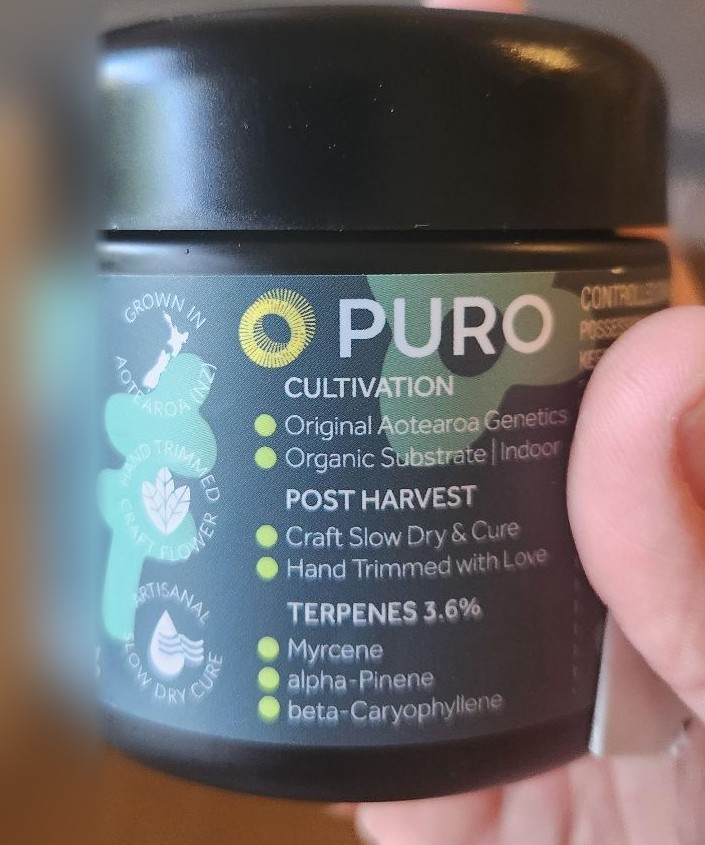 Posted on r/MedicalCannabisOz in November 2024. I've blurred the product name.
"Craft Slow Dry & Cure" is what the product sheet calls "hang dried" and "cured for 2-4 weeks". In other words, a hang dry, not the live drying Puro is known for. As for "Hand Trimmed with Love", I've taken a flower product through verification here, and I've no idea how anyone would prove that one from a manufacturing perspective to permit it being on a domestic label.
Another user replied that, considering Puro grows "in coco with H&G nutes", it "seems pretty damn misleading to have the word organic anywhere on there". Tom Forrest answered as TomForrestCF, opening with "As one of the Puro team, I am happy to jump in here."
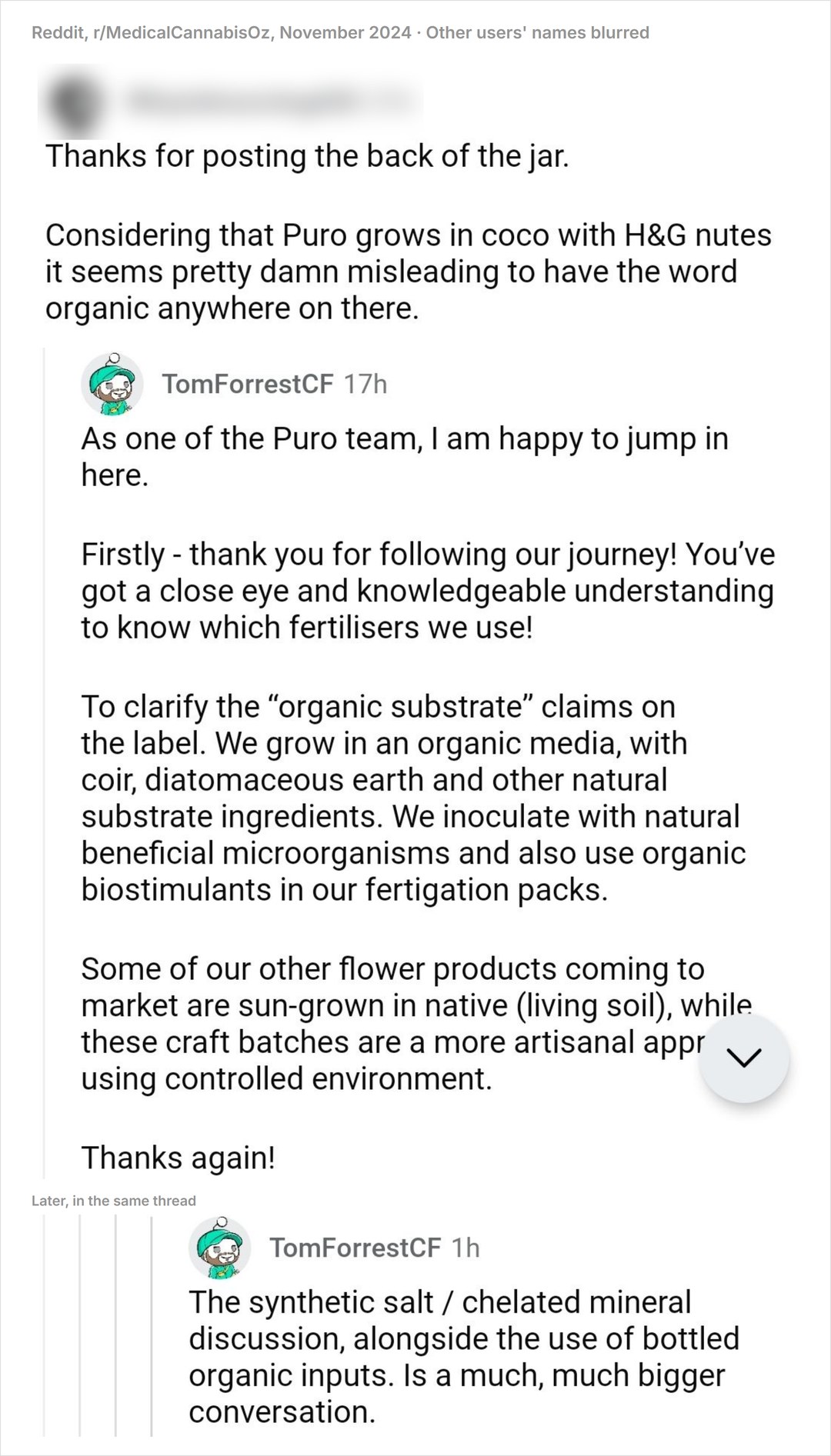
His reply didn't dispute the H&G part. He thanked them for following Puro's journey, and said they had the "knowledgeable understanding to know which fertilisers we use". Then he explained the label. "We grow in an organic media, with coir, diatomaceous earth and other natural substrate ingredients." He said Puro inoculates with "natural beneficial microorganisms" and uses "organic biostimulants in our fertigation packs". And he said that while some of Puro's other flower "coming to market" is "sun-grown in native (living soil)", "these craft batches" use a "controlled environment".
Later, under a comment that "Synthetic nutrients from a bottle is not organic", he wrote "The synthetic salt / chelated mineral discussion, alongside the use of bottled organic inputs. Is a much, much bigger conversation."
Reddit now shows "Comment deleted by user" where his first reply was. The second one is gone too, and his profile shows no comments at all. The screenshots above were taken at the time, while they were still up. I can only speculate at why Tom would have removed those posts since.
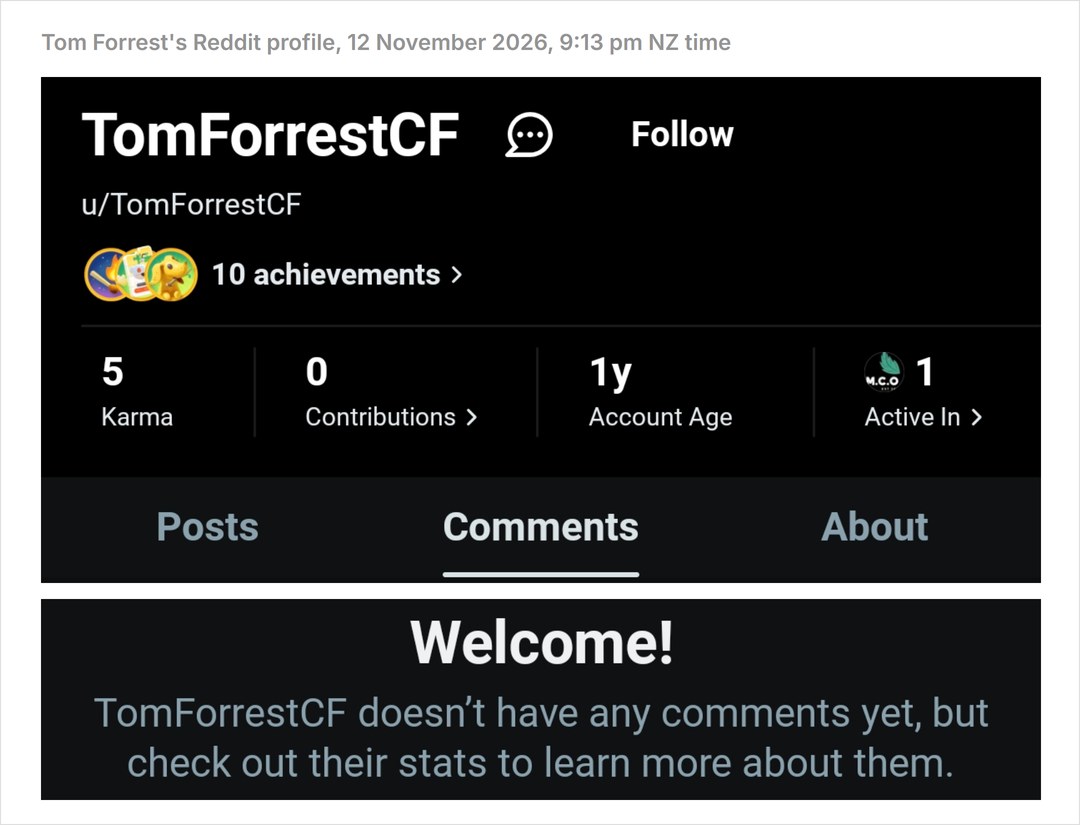
So "organic substrate" means the coir the plants grow in. Coir is coconut husk, so it is organic matter. But Puro's own FAQ says organic certification means growing "without synthetic chemicals and fertilisers", and this flower's product sheet lists House & Garden and Plant Mechanics fertiliser solutions. Nothing in Tom's replies says otherwise. If you ask me, putting "Organic Substrate" ahead of "Indoor", on a jar Puro's own co-founder calls a controlled environment craft batch, is the same pattern again. It's technically true, and it leaves patients to assume the rest.
Organic, until it's exported?
The organic flower from Kēkerengū has its own problem, and the programme knew about it. The programme's mid-term review in 2024 said "A major hurdle identified is the requirement for irradiation in pharmaceutical inhalation products, which conflicts with organic certification rules." It described irradiation as "prohibited in organic certification but often necessary for meeting pharmaceutical standards", and Puro's alternatives as "still in the exploratory phase".
Two years on, Puro's annual report says it's still working on it. Among the programme's achievements for the year, it lists exploring ways "to reduce the need for irradiative sterilisation". Elsewhere it says Puro is "evaluating alternative technologies that could allow us to supply fully organic, non-irradiated flower to international markets".
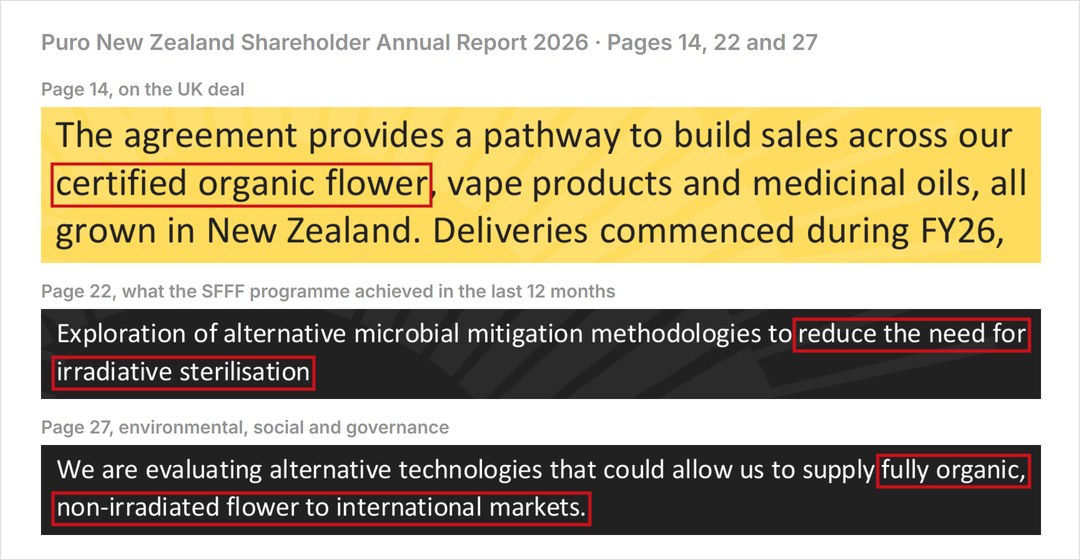 Puro's annual report to shareholders, 2026, pages 14, 22 and 27
Read that last line again. If Puro is still working out how to supply fully organic, non-irradiated flower overseas, what's it supplying now? The same report tells shareholders its UK deal is a pathway for "our certified organic flower". IPS Pharma, its UK partner, sells it as "organic, sun-grown, live-dried flower" from "one of the world's few certified organic cannabis producers".
Puro's own material for UK prescribers is more careful. Pandalorian is "Grown with certified organic methods", and Ultra Pink was "produced under accredited organic methodologies". Neither says the flower itself is certified organic.
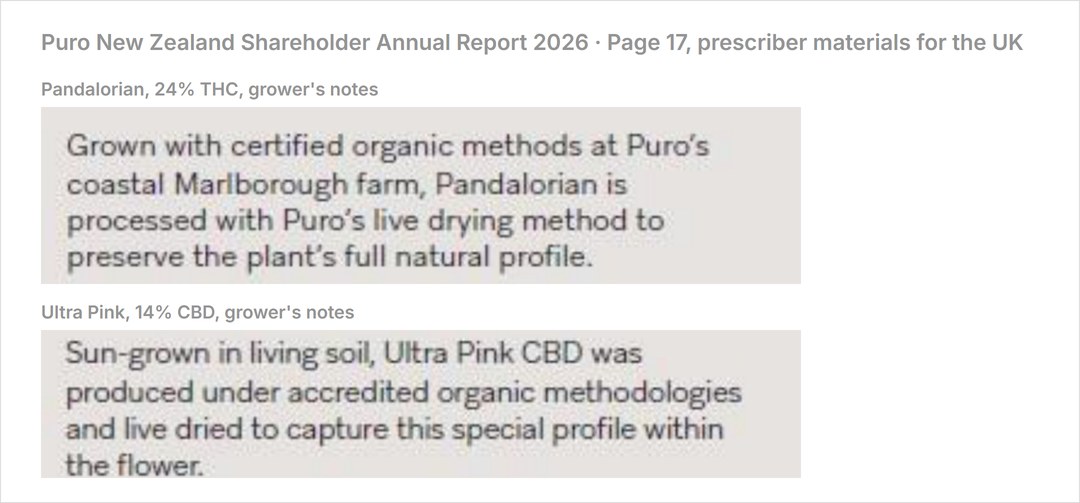 Puro's annual report to shareholders, 2026, page 17
Puro's own website is less careful. Its UK news post on 3 November pitches "Sun-grown, certified organic flower from New Zealand" to Europe, and says being certified organic gets it noticed.
To be fair, irradiation is legal and common, and the report doesn't say which flower is irradiated or where. The farm's certification is real. But "certified organic flower" for shareholders, "organic" for UK buyers and "certified organic methods" for prescribers aren't the same claim. So which of Puro's exported flower is irradiated, and is any of it still being sold as organic? For the UK, we already know. Everywhere else, Puro hasn't provided a straight answer.
And Puro's first contract growing site is now up and running. Back in April, Puro said its iwi partner, Te Rūnanga o Kaikōura, would grow "on their own land". But from Puro's own video of the planting, it looks to be on the Winterhome property at Kēkerengū, the same property Puro leases its own farm from. So why hasn't it been done on the iwi's own land yet? Will contract growers' flower be certified organic, and will it still be sold as organic if it's irradiated for export?
Can a New Zealand patient get any of it?
Back to the flagship. In November 2024, the NZ Herald reported on the Heyday deal that "Kiwis who need access to the therapeutic won't be able to get it". Sank Macfarlane told the paper "we'd love for New Zealand patients to be able to benefit from it", and that "It's not economical for us to go through the time-consuming rigmarole of applying for an import licence to bring our own product back to New Zealand". Two years on, the only New Zealand route in Puro's FAQ is "Helius Therapeutics full spectrum oils".
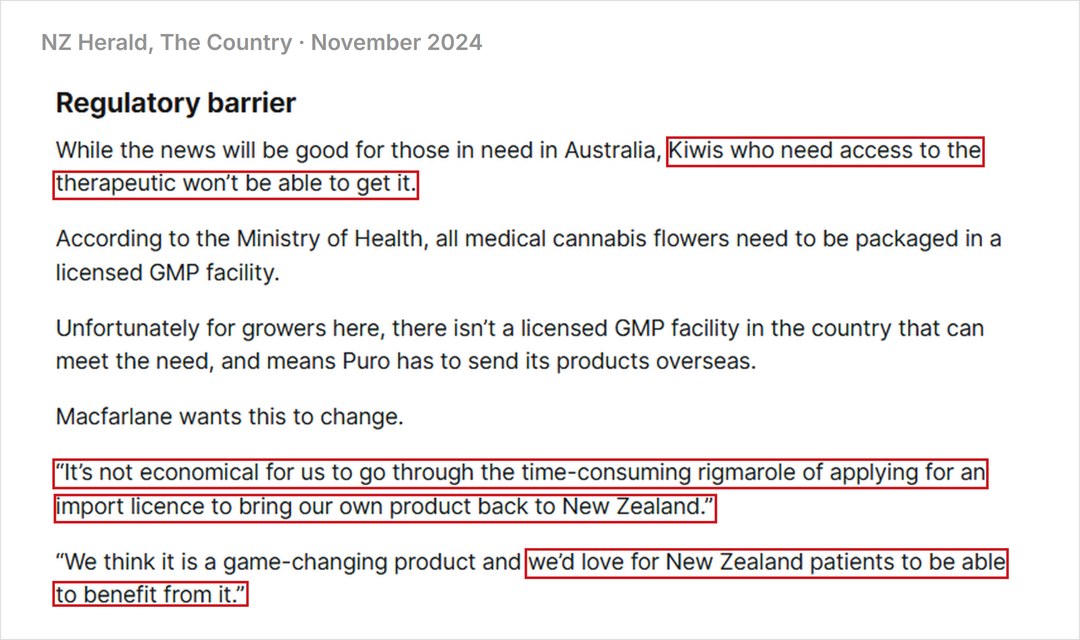 NZ Herald, November 2024
"Not economical" is a business choice, not a barrier. Other New Zealand growers already take that route. As I wrote last month, NUBU has NZ-grown flower from Kalyx, Organic Greenz Group and others packed in Australia and brought back for New Zealand patients. As far as I can see, nothing stops Puro doing the same with Kākāriki Koha. It just costs money.
So here's a question for you. If Puro's flagship was developed with help from a $13 million New Zealand grant, and it's the kind of flower New Zealand manufacturers can already pack, why can't a New Zealand patient get it?
Puro has complained about New Zealand's rules before. As well as the "time-consuming rigmarole" above, its COO told Marlborough Now last year that "we're so restricted by what we can promote". But those restrictions are there for a reason. In New Zealand, you can't advertise an unapproved medicine to the public, and that's most medicinal cannabis products. No medicine ad is allowed to mislead people about a product's nature, quality, purity or origin either. That includes any certifications. Rules like that are there so patients aren't sold a story instead of a product.
I'm vehemently opposed to loosening them. If you ask me, the regulator has to be careful, because these are the types of things companies try to get away with. And to be clear, I don't condone this type of skulduggery from any company, not just Puro.
The story so far
This is my fourth post on Puro's programme, so here's where it stands. Taxpayers put $13 million into it, on promises of medicine for Kiwi patients, a handbook for the wider industry, a pilot glasshouse and 200 jobs by 2026. Four and a half years on, Puro says it's blocked from supplying Kiwi patients while other NZ growers already do, and the glasshouse was never built. MPI won't release most of the paperwork, the handbook is now due at the end of 2027, and the jobs target is now "up to 200" by 2034. Set against Puro's own annual report, the programme came to 95% of its production and operating costs in the year to June 2025. And Puro sells itself as certified organic, while its flagship, Kākāriki Koha, is grown indoors with House & Garden fertiliser, and its jar says "Organic Substrate | Indoor". So what are taxpayers actually getting for their $13 million?
I've still got two requests in with MPI, one on when the quarterly reports go up and one for the yearly jobs figures. Both are due by mid-December. On 23 November I also sent BioGro, Puro's organic certifier, questions about what Puro's certification covers, along with a complaint about how "organic" is being used around products that, as far as I can tell, sit outside it. I'll share what comes back.
If MPI or Puro think I've got any of this wrong, I'll correct it.
Sources
- Puro New Zealand, Shareholder Annual Report 2026, 1 July 2025 to 30 June 2026 (not public): pages 3, 4, 5, 6, 14, 17, 22, 27 and 70.
- Puro New Zealand, Annual Report 2024 (not public): page 14, Kākāriki Koha and Heyday's chief medical officer, and pages 62 and 63, Winterhome and the Kēkerengū lease.
- Puro New Zealand, Shareholder Annual Report 2025 (not public): pages 66 and 67, Winterhome and the Kēkerengū lease.
- Beehive, 8 April 2022, Govt helps fast-track organic medicinal cannabis industry: the Minister's announcement.
- Puro, March 2025, Kākāriki Koha product sheet (PDF): how it's grown, dried and packed.
- Puro, FAQ, products, global growth, innovation and people and progress pages, as at 10 November 2026.
- Puro, homepage, as at 19 November 2026: the line MedBud's About Puro panel opens with.
- Puro, quality page, as at 22 November 2026: Kēkerengū's BioGro organic certification.
- Puro, 3 November 2026, UK expansion: our launchpad into Europe: certified organic, pitched to UK and European buyers.
- Puro, 9 April 2026, 65,000 plants, seven years in the making: Te Rūnanga o Kaikōura to grow on its own land, with Puro processing and selling the harvest.
- Hydrobuilder, House & Garden Cocos A: the product FAQ.
- RNZ, 13 February 2026, Country's largest medicinal cannabis grower Puro NZ set to harvest biggest crop yet: Tom Forrest's role at Puro.
- AusCannaPodcast, 24 April 2025, S3 E6, Growing With Intention: A Conversation with Tom Forrest, from about 14:45 and 30:35: Stealth Garden, the brands it represents, sourcing inputs and Norwegian kelp. Both audio clips are short excerpts from this episode.
- Stealth Garden, about page, archived July 2017 and home page as at 10 November 2026: the team listing, the brands, and wholesaling across Australia and New Zealand.
- Cannabis Europa, speaker profile for Tom Forrest, London 2026, as at 10 November 2026 (archived copy): his role at Stealth Garden Wholesale.
- Indicated Technology, home page and specialists page as at 10 November 2026 (archived copies of the home page and specialists page): Tom's roles and the brands it distributes.
- ASIC, company extracts for Indicated Technology Pty Ltd (ACN 616 462 787) and SKAH International Pty Ltd (ACN 127 490 073), 10 November 2026: directors, shareholdings, and Stealth Garden's place of business. ABN Lookup shows Stealth Garden is SKAH's registered business name.
- Companies Office, Puro New Zealand Limited shareholdings as at 10 November 2026: Indicated Technology Pty Limited's 2,388,330 shares and its address.
- Pharmacy Daily, 13 November 2024, Puro's new deal: the Australian launch of Kākāriki Koha.
- IPS Pharma, 1 July 2025 and 31 March 2026: how Puro's UK partner describes the flower.
- MedBud UK, Puro's producer page and its product pages, checked 19 November 2026 (archived copy from May 2026, when it listed the first five): the nine Puro flowers listed in the UK, their names, irradiation, the About Puro panel, and the Ultra Pink page's photo of the bag.
- Marlborough Now, 22 November 2025, Pure and Simple: the COO on organic, and on what Puro can promote.
- NZ Herald, November 2024, Medicinal cannabis company Puro secures Australian deal (subscriber article, checked 10 November 2026): the Heyday deal, and what it meant for Kiwi patients.
- AusCannaReviews, 17 March 2025, Heyday's Kākāriki Koha (Green Gift) Flower Review (both quotes are in the free preview).
- Newsweed, 17 November 2026, New Zealand cannabis is making its way to Europe, and its terpenes are on fire (archived copy), shared by Puro on LinkedIn on 18 November 2026: open fields over indoor facilities, and Waihopai.
- Medicines Act 1981, sections 20 and 57: no advertising unapproved medicines, and no misleading medicine ads.
- Reddit, r/MedicalCannabisOz, November 2024, a thread about Kākāriki Koha: the photo of the jar, and Tom Forrest's replies as TomForrestCF, from screenshots taken at the time. Other users' names are blurred.
- Puro on Instagram (@puronz), November 2026: a post that says "our first contract growing site became operational", with a video of the planting, and mentions the "forthcoming 'Organic Cannabis Growers Guide'".
- Peak Projects NZ, October 2024, Puro mid-term programme review, pages 22 and 50: irradiation and organic certification, and the Indoor Cultivation Systems workstream.
- Field Notes, 19 October 2026, Why are taxpayers funding Puro to do what Puro says can't be done?: what Puro's FAQ says about packing in New Zealand, how my own flower gets packed here, and how NUBU brings NZ-grown flower back from Australia.