Who's paying to run Puro?
In my last post I wrote that MPI won't release the programme's spending by workstream, most of its annual plan or its audit. This means that taxpayers can see how much money goes into it, but not what that money is specifically paying for.
Since then I've seen Puro's latest annual report to shareholders. It isn't public and Puro says their reporting hasn't been audited, but it's Puro's account of its own money, and it fills in a lot of what MPI won't. Everything below sets Puro's figures against the quarterly reports Puro files with MPI, which are public.
Usual disclosure applies: I help people get licensed to cultivate, I've freely shared my own SOPs, and through Pause Labs / Chill Division I've got NZ-grown flower of my own on the market here in Aotearoa New Zealand. I'm not a neutral party, which is exactly why everything below is quoted with source references for you to check.
The programme is nearly the size of the company
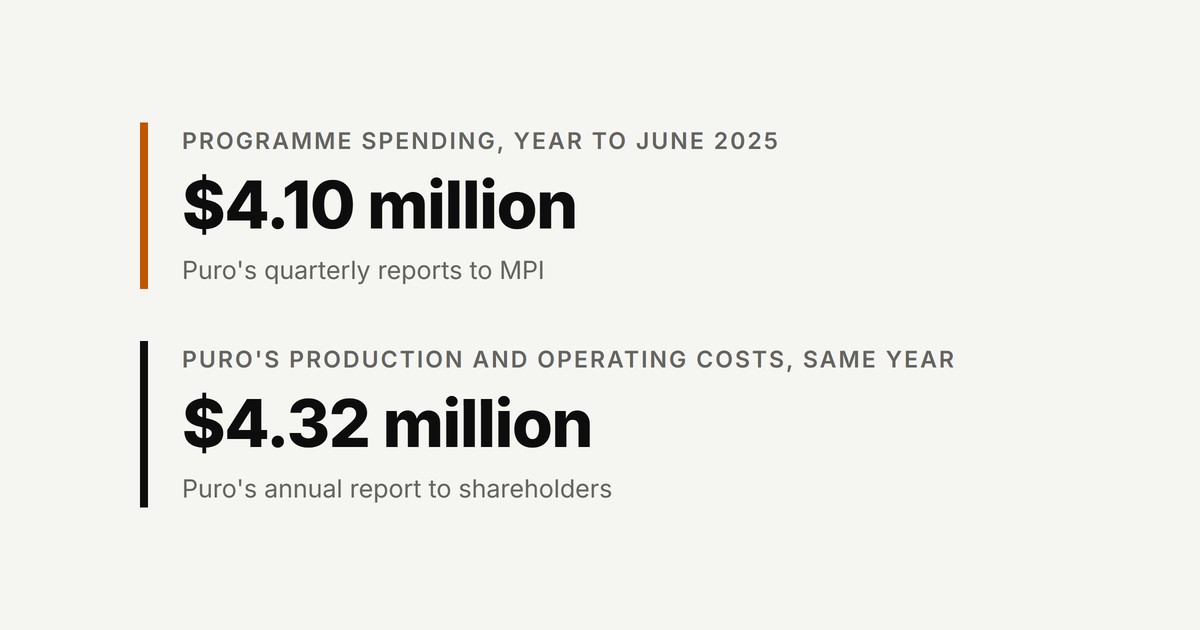
Each quarterly report to MPI ends with a table of what the programme spent that quarter, split between Puro and MPI. Puro's financial year runs from July to June, so four of those quarters line up with each of its years. They line up well, too. MPI's share in those quarters matches the government grant income in Puro's accounts to within $2.
Here's how the two compare.
| Year to June 2025 | Year to June 2026 | |
|---|---|---|
| Programme spending, from Puro's reports to MPI | $4.10 million | $6.59 million |
| MPI's share of that | $1.66 million | $2.66 million |
| Puro's production and operating costs, from its annual report | $4.32 million | $8.02 million |
| Programme spending as a share of those costs | 95% | 82% |
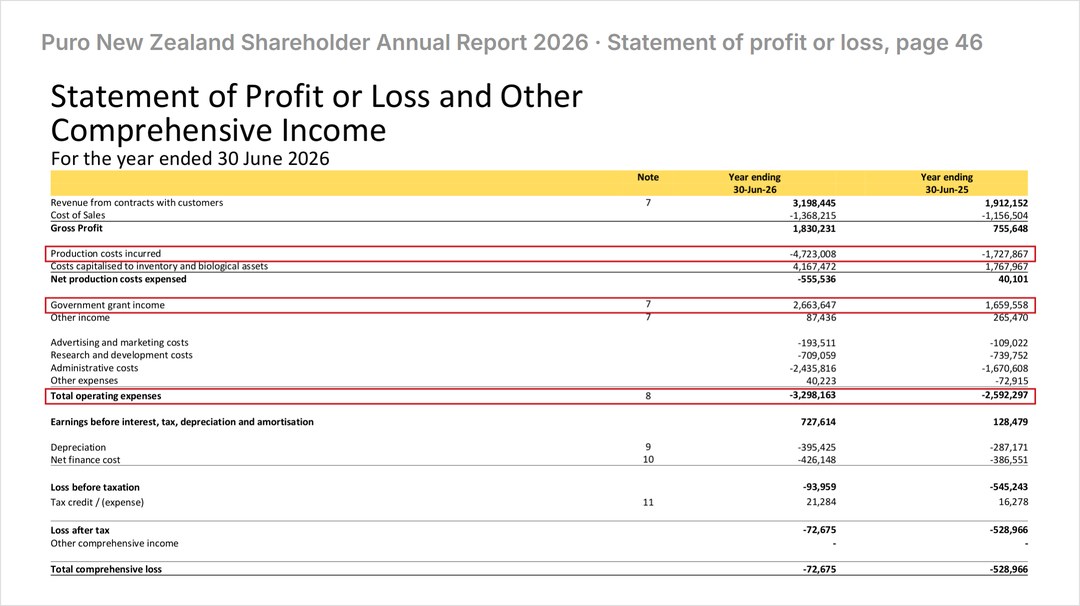 Puro's annual report to shareholders, 2026, with the year to June 2025 alongside
Production costs incurred is what Puro says it spent growing and processing that year. Total operating expenses covers its admin, research, and advertising and marketing. I've left out cost of sales, because that's mostly the cost of stock grown in earlier years, so counting it would count the same crop twice.
Granted, there's more to a company's spending than that. But count the rest too, the equipment Puro bought (leaving out the $1 million Waihopai land) and its finance costs, and the programme still comes to about four-fifths of Puro's spending in the year to June 2025, and about three-fifths the year after.
What MPI's rules say
MPI's guidelines for applicants are clear about what this fund is for. They say a proposal must go beyond business as usual, for the applicant and the wider industry, and that "business as usual activities and normal operating costs" are ineligible. They also say Crown funding "should not replace private sector funding sources".
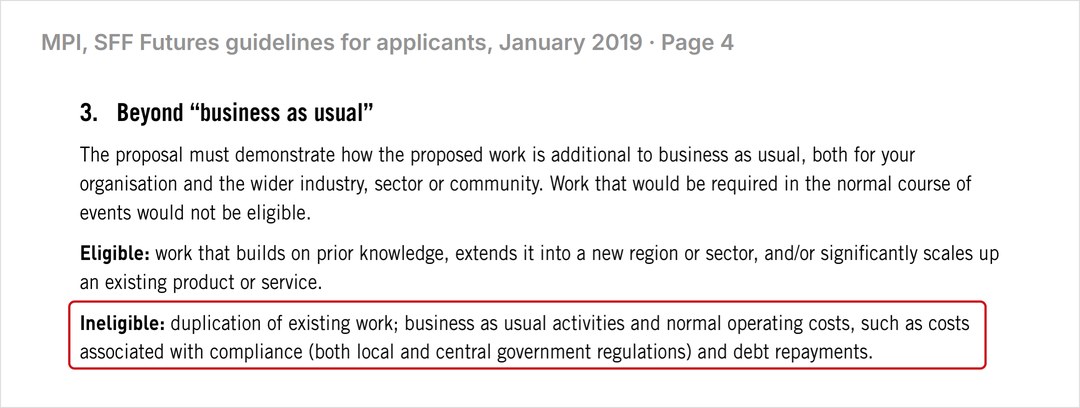 MPI, SFF Futures guidelines for applicants, January 2019, page 4
Those rules are from January 2019, three years before Puro's programme was announced.
So here's my question. In the year to June 2025, the programme spent $4.10 million and Puro's production and operating costs came to $4.32 million. If the programme's spending was all growing, processing and running costs, about $217,000 of Puro's running costs sat outside it. If it also covered what Puro spent on equipment and buildings, apart from the land, that rises to about $695,000. At most, that's roughly what Puro paid its five key managers that year, $649,892. So which part of running Puro was the business as usual?
To be fair, MPI's guidelines allow in-kind contributions, like staff time, case by case. If some of Puro's share was in-kind rather than cash, more of its real spending would sit outside the programme. Neither MPI's reports nor its answers to me say whether it was.
The business as usual question goes back to day one, too. The programme's most expensive quarter so far was its very first, at $2.29 million, and its headline achievement was the "Successful harvest of nearly 50,000 plants at the organic Kekerengu facility". That crop was already in the ground when the funding was announced. The report says the programme compiled baseline data from that harvest, which is fair enough. But I asked in October whether the cost of growing it was counted as programme spending. Puro didn't answer, and MPI won't release the numbers that would.
The grant keeps the lights on
Puro's report tells shareholders the year to June 2026 was "close to break-even on the bottom line". It lost $72,675. But that's after $2.66 million of government grant income. Take the grant out and Puro was nearly $2 million in the red before interest, tax and depreciation, worse than the year before. For every dollar of product Puro sold that year, MPI put in about 83 cents.
Puro's own directors lean on the grant too. In the going concern note, where directors explain why they think a company can keep paying its bills, they list "contracted government funding" among their reasons. Then they say the uncertainties "may cast significant doubt" on Puro's ability to carry on.
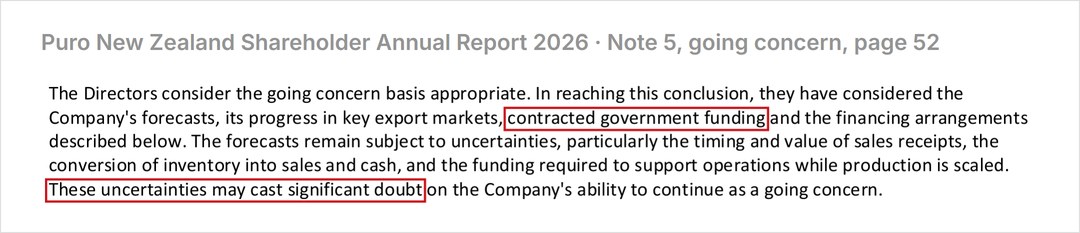 Puro's annual report to shareholders, 2026, note 5
Sales missed the forecast
That going concern note leans on Puro's forecasts as well, so it's worth checking how the last ones went.
I've seen last year's annual report too. In November 2025, it forecast sales of $5.4 million for the year to June 2026, and $13.2 million for the year after. It also said "More than 80% of this revenue is already contracted".
Puro sold $3.20 million. That's $2.2 million short of its forecast, and more than $1.1 million short of the part it said was already contracted.
This year's report compares the $3.20 million with earlier years, and calls it "our strongest year for revenue". Its new forecast for the year to June 2027 is $6.4 million, less than half the $13.2 million it forecast a year ago.
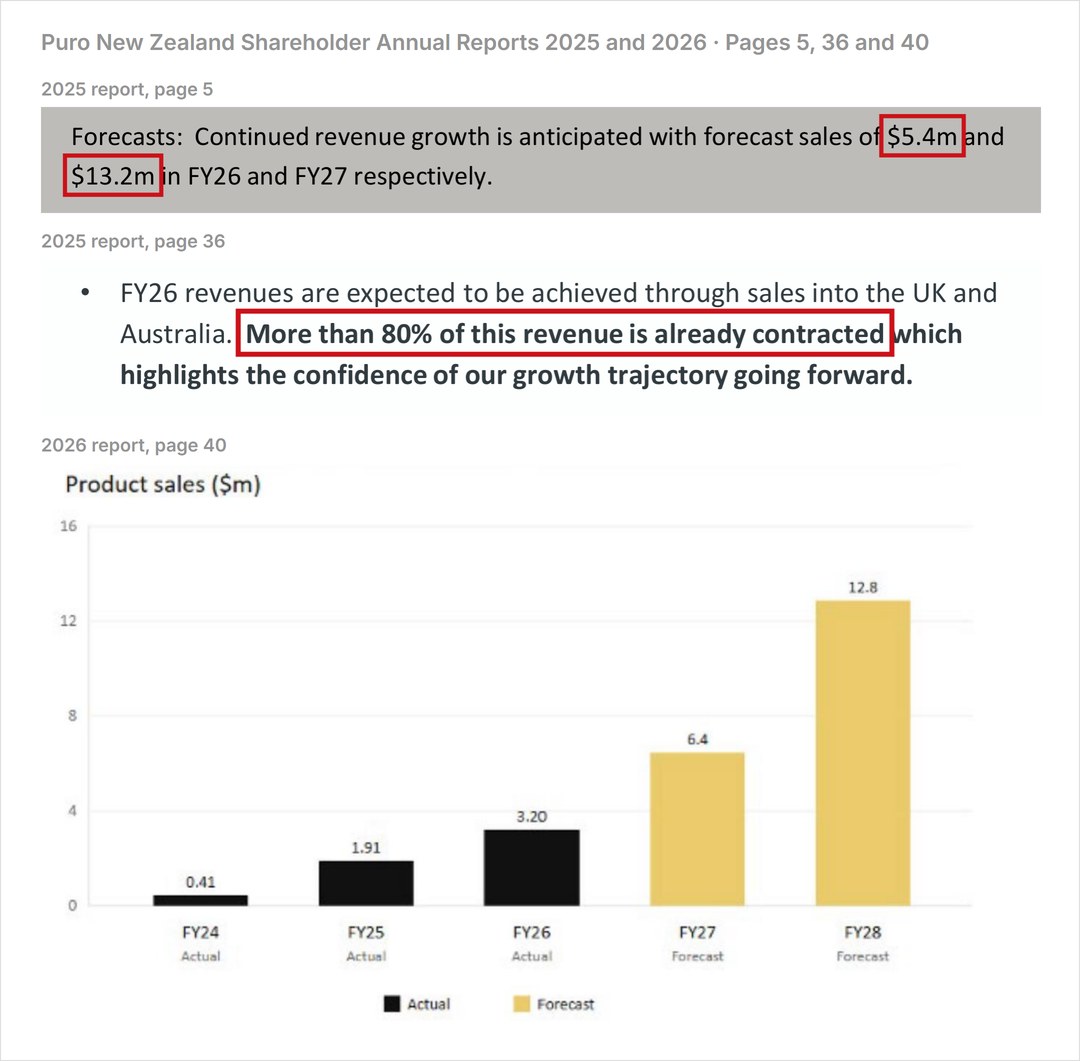 Puro's annual reports to shareholders, 2025 (pages 5 and 36) and 2026 (page 40)
In Puro's defence, its directors say "UK label rules significantly delayed our shipments into market", and export deals do take time. But this year's going concern note leans on the same kind of forecast, with "More than 50% of forecast FY27 revenue" contracted. If you ask me, when even contracted sales don't arrive on time, it's the grant keeping Puro going. And as I said last week, contract growers need buyers. This isn't the pipeline I'd want to be signing them up on.
Pay went up
In the year the programme's spending jumped 61%, Puro's key managers, its two directors and three executives, were paid $974,705 between them. That's up 50% on $649,892 the year before. The two directors, Tim Aldridge and Sank Macfarlane, got $215,000 and $280,021, which includes their salaries as employees.
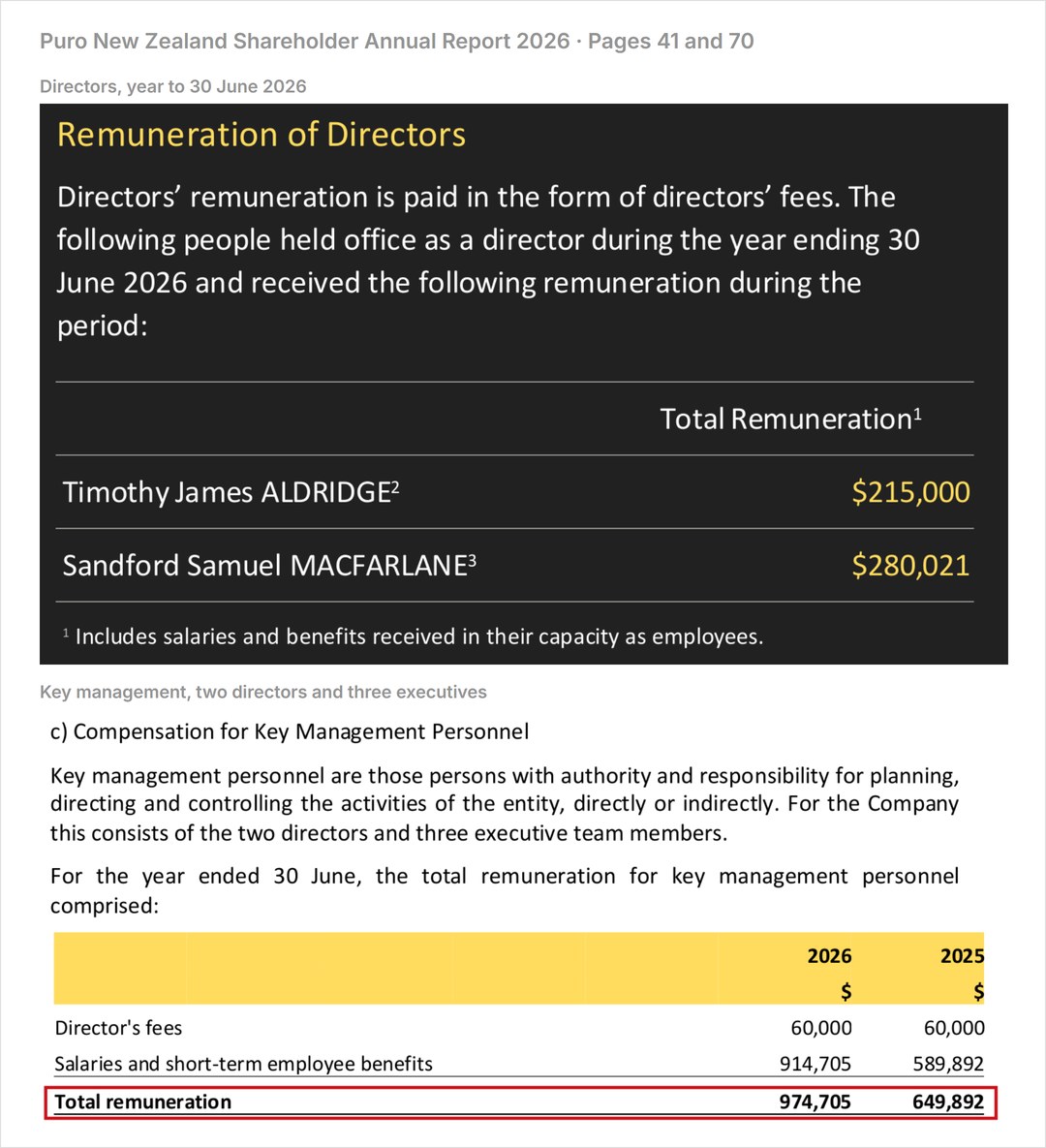 Puro's annual report to shareholders, 2026, pages 41 and 70
People have to be paid, of course, and some of their time really is programme work. The mid-term review forecast about $1 million for programme management over five years. But MPI wouldn't release the spending by workstream, so there's no way for the public to see how much of the programme pays Puro's own people.
What the programme is buying
Puro's report is pretty open about what the programme has done for the business. Talking about its hash, rosin and distillate, it says of the programme's research, "That work has taken product from concept through to commercial formats we can now sell."
Admittedly, turning research into products is the whole point of the fund. But when the programme is 95% of a company's production and operating costs, it's hard to tell where the research stops and the business starts.
MPI says the recommendations from its 2024 audit have been addressed. I'm not saying any claim broke the rules, because I can't see the claims. Nobody outside MPI and Puro can, and that's the problem.
The updates only come when I ask
Taxpayers do get one regular window into this programme. Each quarter, Puro reports to MPI, and MPI publishes a short public summary on its website. That's the idea, anyway.
When I rang MPI on 30 March, the newest report on its website covered April to June 2025, a quarter that had ended nine months earlier. The reports for the two quarters after that were nowhere to be seen. The next afternoon, the public versions of both were made, at 1:51 pm and 2:33 pm according to the files' own details. At 2:42 pm, MPI's contact centre emailed me to say the public summaries "will be uploaded in the next two weeks". By 4:45 pm the next day, MPI's fund team told me the website "has now been updated to include the latest Quarterly Reports for the Puro programme".
Then it happened again. The next report, for January to March 2026, still wasn't up in June, so on 7 June I asked about it. On 10 June, MPI told me "These reports are not uploaded immediately after the completion of a programme quarter", and that it expected to publish within one to two weeks. That file says it was made on 11 May, and last changed at 3:55 pm on 10 June, 13 minutes after MPI's reply.
When I last checked, on 11 November, the newest report on MPI's site was from July 2026. There was nothing yet for July to September.
MPI publishes these, and its own investment manager is listed as the author on two of the recent files. Back in 2024, the mid-term review said the programme's governance group, which includes two MPI staff, commended the programme's reporting for its "timeliness". So whoever's been holding them up, three reports in a row only went public after I asked.
In my opinion, the public updates on a $13 million programme shouldn't depend on someone ringing up to ask where they are.
What I'd like MPI to answer
- Did MPI know the programme's spending was 95% of Puro's production and operating costs in the year to June 2025?
- How does MPI check that programme costs aren't "business as usual activities and normal operating costs"?
- How much of the programme's spending has paid Puro's directors and executives?
- How much of Puro's 60% share is cash, and how much is in-kind?
- Puro's sales for the year to June 2026 came in $2.2 million under its own forecast. How does MPI check that Puro can keep paying its 60% share?
- Why did Puro's public progress reports only go up after I asked, and how soon after each quarter is MPI meant to publish them?
What I'd like Puro to answer
Puro is a private company, but given it's the recipient of public funding, these questions certainly seem in line with the public interest in knowing how taxpayer dollars are being spent. Earlier this month, Puro said on Instagram that "our first contract growing site became operational", so I'll start there.
- Where will Puro's contract growers' flower be sold, and how much of it is already contracted?
- Do contract growers get a guaranteed buyer and a set price for their crop? If Puro's sales come in under forecast again, who carries the risk, Puro or the growers?
- Whose licence are the contract growers growing under, and who pays for the licensing, security and testing?
- IPS Pharma says its UK supply deal with Puro is worth £7 million (NZ$16.1 million). How much of that has actually been delivered so far?
- The same Instagram post mentions a "forthcoming 'Organic Cannabis Growers Guide'". Is that the programme's handbook? If so, will it be the whole handbook, free for any grower, or will part of it be kept "only for Puro and/or contract growers", as the mid-term review discussed?
- Will the genetics the programme helped develop be freely available to other New Zealand growers, or will they have to buy them from Puro?
- How many non-seasonal FTEs (full-time equivalents) work for Puro now? MPI didn't give me a jobs figure.
- Was any of the $2.29 million in the programme's first quarter spent growing a crop that was already in the ground when the funding was announced?
- What's Puro's plan for when the programme money stops?
If you ask me, this has stopped looking like a research programme. It looks like life support.
Sources
- Puro New Zealand, Shareholder Annual Report 2026, 1 July 2025 to 30 June 2026 (unaudited, not public): pages 3, 24, 40, 41, 46, 52 and 70. Figures for the year to June 2025 are the comparatives in the same report.
- Puro New Zealand, Shareholder Annual Report 2025, 1 July 2024 to 30 June 2025 (unaudited, not public): pages 5 and 36, the sales forecasts for the years to June 2026 and June 2027.
- Puro's quarterly progress reports to MPI, investment tables: April 2025, July 2025, April 2026 and July 2026. The year to June 2025 is quarters two to four of year three plus quarter one of year four. The year to June 2026 is quarters two to four of year four plus quarter one of year five.
- MPI, January 2019, SFF Futures guidelines for applicants (archived copy), pages 4 and 11: business as usual, Crown funding replacing private funding, and in kind contributions.
- Puro's first quarterly progress report to MPI, July 2022: the first quarter's $2,285,020, the harvest highlight, and the baseline data from the 2022 harvest.
- RNZ, 11 April 2022, Cannabis farm gets $32m cash boost (via SunLive): the two-week harvest of 51,000 plants kicking off where the funding was announced.
- Puro's quarterly progress reports to MPI, file details (creation and change times, and author): October 2025, December 2025, April 2026 and July 2026.
- MPI, emails to me on 31 March, 1 April and 10 June 2026, about when the quarterly reports would go up.
- Peak Projects NZ, October 2024, Puro mid-term programme review: the programme management budget, the governance group and its two MPI members, and its comment on the reporting's "timeliness" (the "Programme Management and Governance" section), and the MPI investment manager's role (Appendix 4, list of interviewees), and the idea of a version of the handbook "only for Puro and/or contract growers".
- MPI, 9 November 2026, OIA26-0833, MPI's response to my request (PDF, 240 KB): the workstream spending, annual plan and audit that MPI withheld, and the jobs figure it didn't give.
- Property sales records: the $1 million price of Puro's Waihopai land, settled in May 2025, as covered in my last post.
- Puro on Instagram (@puronz), November 2026: a post that says "our first contract growing site became operational", and mentions a "forthcoming 'Organic Cannabis Growers Guide'".
- IPS Pharma, 1 July 2025 and 31 March 2026: the £7 million (NZ$16.1 million) supply deal with Puro, and the first shipment under it.