What MPI won't tell taxpayers about Puro
Last month I wrote about why taxpayers are funding Puro to do what Puro says can't be done. At the end of it I said I'd lodged a follow-up Official Information Act (OIA) request with MPI, asking for documents, not opinions, and that I'd publish what came back. MPI answered on 9 November, only just inside the 20 working days the law allows. You can read the whole response here.
The short version is that MPI refused nearly all of it, mostly as "commercially sensitive". But a few new facts did come out, and the biggest one is about the handbook. It's now due at the end of 2027, after the programme was originally meant to finish.
What I asked for, and what I got
I asked for twelve things (OIA26-0833). Here's how each one landed.
| What I asked for | MPI's answer |
|---|---|
| The funding agreement and its variations, including the terms on intellectual property and sharing results | Withheld, apart from three sentences on the glasshouse change and market access |
| The business case, and MPI's own assessment of it | Withheld |
| The current annual plan and milestones | Withheld, apart from a one-page excerpt of this year's priorities (Appendix One) |
| The "full external financial audit" | Withheld, with a short summary |
| Spending by workstream | Withheld |
| How the 200 FTE target is defined and measured, and how many cadets have been employed | Three cadets, plus an updated logic model (Appendix Two) |
| Governance decisions, including any decision on a confidential handbook | Stop/Go records withheld, plus a statement about the handbook |
| The confidential version of the mid-term review, and the self-assessment it recommended | Withheld. The self-assessment wasn't done |
| The protected cropping enclosure at Waihopai | Withheld. It's "still being considered for feasibility" |
| Handbook drafts, including the "detailed draft" from 2022 | Withheld |
| Travel and event spending | Not held by MPI |
| Plans for the final evaluation | Don't exist yet |
For nine of the twelve, MPI relied on section 9(2)(b)(ii) of the OIA, twice alongside a confidentiality ground. That section covers information where release "would be likely unreasonably to prejudice the commercial position of the person who supplied or who is the subject of the information".
Neither appendix came with the letter, but MPI sent both the same day I asked. I've covered them below.
The handbook is now due at the end of 2027
In April 2022 the Minister promised "a production handbook that will be available to the wider industry". In October 2022, the programme's progress report said a "Detailed draft of Organic Production Handbook was completed". By the October 2024 mid-term review, the handbook's forecast budget had grown from $6.57 million to $8.04 million.
In July this year, Puro's report to MPI listed this among its upcoming activities. "External peer-review process will be completed on the handbook and final formatting of pdf version will be completed."
Here's where it's at now.
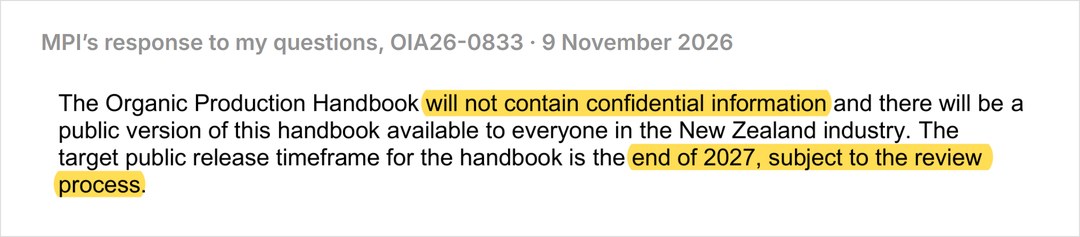 MPI's response to my questions, OIA26-0833, 9 November 2026
That's more than five years after the "detailed draft", and it still comes with a caveat.
It's also after the programme was meant to end. The Minister announced it as running "from 2022 to 2027", and MPI's letter calls 2026/27 "Year five". In my last post I said the handbook could still arrive before the original end date. MPI's own target is now later than that.
Let's put that in perspective. By the end of 2027, it'll be more than five and a half years since the Minister's announcement, for a growing guide with a forecast budget of $8.04 million. That budget does cover developing the growing protocols, not just the writing. But MPI won't say how it's been spent, so nobody outside the programme can check.
It's never looked like much of a priority, either. In September 2023, Puro co-founder Tom Forrest told me the handbook came after sales and cultivation on his list. And Puro's own FAQ describes the grant like this. "The grant focuses on five key areas: genetics development (including our flagship Kākariki Koha cultivar), organic cultivation systems, post-harvest processing, live drying technology implementation, and workforce and skills development." The handbook isn't one of them. It isn't mentioned anywhere in the FAQ.
So ask yourself this. How does a growing guide end up with an $8 million budget? If a detailed draft existed in 2022, what's taken the next five years? And if the handbook wasn't a priority for the person leading it, and isn't worth a mention in Puro's own FAQ, whose priorities has the public been paying for?
For comparison, Chill Division is basically just me. Last month I made our cultivation SOPs free for everyone at sops.chilldivision.co.nz, all 129 pages. They were behind eight cultivation licences in 2025 alone. Pause Labs grows under them, and following them got its flower verified by the Medicinal Cannabis Agency in December 2025 and into New Zealand pharmacies by February. None of that cost the taxpayer a single cent.
Granted, they're SOPs for getting licensed and running a cultivation facility, not an organic growing guide, and Puro grows at a much bigger scale. Still, they show what a practical guide looks like when someone actually wants it finished.
But back to Puro. MPI also wouldn't release any draft, including the one from 2022.
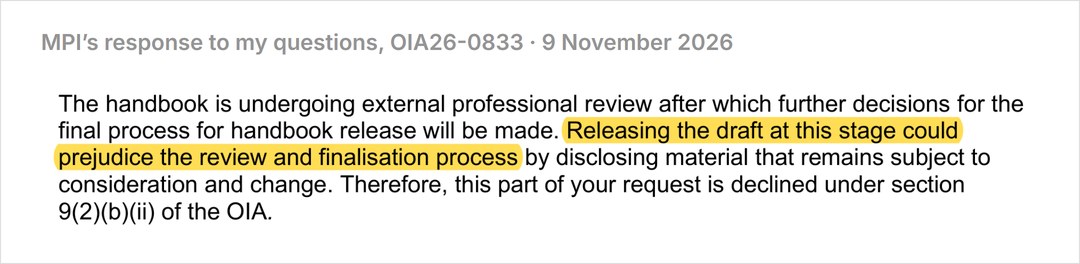 MPI's response to my questions, OIA26-0833, 9 November 2026
MPI refused the drafts under the commercial ground, section 9(2)(b)(ii). But the reason it gave is about the review process, not anyone's commercial position. I'd also said a table of contents would do if the drafts couldn't be released. MPI didn't provide one.
If you ask me, it's hard to see how a draft from 2022 could prejudice a review happening four years later. Releasing it would also clear up what actually existed back then, because the same October 2022 report's summary calls it a "detailed outline".
What happened to the confidential version?
In May, MPI told me "the development of a confidential version for Puro appropriately reflects the balance of public and private investment". Now it says the handbook "will not contain confidential information" and that there will be "a public version of this handbook available to everyone in the New Zealand industry".
That sounds like good news, and maybe it is. But if you ask me, "a public version" is an odd phrase if there's only going to be one version. I asked for any governance decision to produce a confidential version, and what would be left out of the public one. MPI didn't release a decision, didn't refuse one, and didn't say none exists. So I still don't know whether Puro is getting its own version.
The mid-term review gives a pretty good idea of who it would be for. "There is considerable IP associated with the handbook," it says. "One way of doing this that was discussed would be to have a version of the handbook that contains public material and another version containing information only for Puro and/or contract growers."
Contract growers are where Puro is heading. In March, Rural News reported that Puro's chief executive, Sank Macfarlane, "says it is keen to develop a contract growing business, like Zespri's kiwifruit framework". The programme's own October 2025 report says "A draft Contract Growers Plan is in development with iwi partners".
Contract growers have been in the plan from the start. Both versions of the programme's logic model pair the jobs target with "a new Contract Grower Model for organic production". And the programme's annual plan for this year, which MPI released as Appendix One, puts contract growers under the handbook itself.
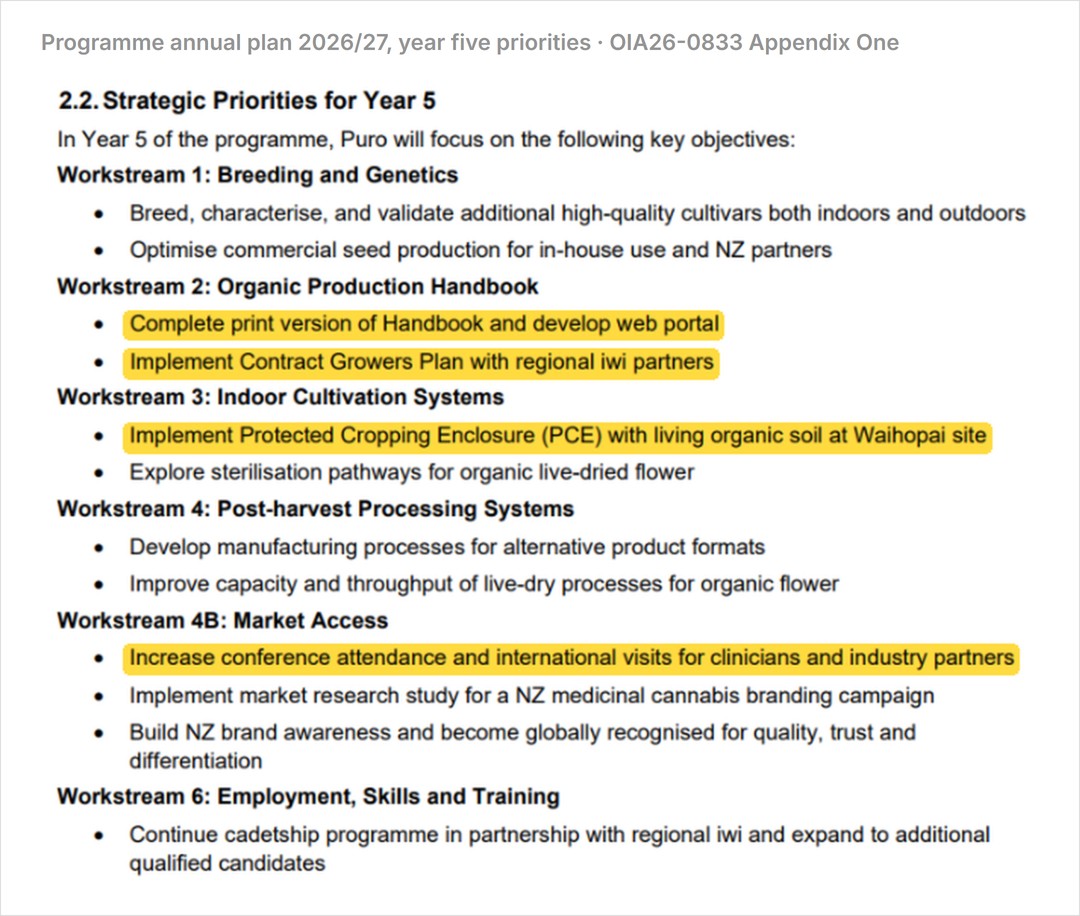 The programme's annual plan for 2026/27, released by MPI as OIA26-0833 Appendix One
Under "Workstream 2: Organic Production Handbook", the two priorities for this year are to "Complete print version of Handbook and develop web portal" and to "Implement Contract Growers Plan with regional iwi partners".
Contract growers need buyers, though, and plenty of them. Puro's own planning consultant told the council in April that "Business growth was slower than expected" in the first few years after its 2021 consents, although the same letter says recent export agreements have picked things up. Either way, if Puro is going to sign up other growers, it'll have to find a lot more buyers for their crops too. If you ask me, Puro signing up contract growers without a solid pipeline is going to be disastrous, not just for Puro, but for the other companies and iwi it signs up as growers too.
And the know-how in that handbook comes from the programme. The review counts Puro's Kēkerengū crops as the handbook's progress, saying the farm "has had three cycles of crops (one per year), each time building on knowledge gained". If you ask me, a version "only for Puro and/or contract growers" would turn publicly co-funded know-how into a private playbook for Puro's own grower network. That's the opposite of the "comprehensive blueprint that other Kiwi companies can use" the Minister announced.
It's not the attitude Tom Forrest told me he had, either. In April 2024, I told him I hated the secrecy, all the cloak and dagger "my intellectual property" stuff. "Me too bro," he replied, before telling me where the "secret sauce mentality" could go. Six months later came the mid-term review, with its talk of a second version. So if the person leading the handbook couldn't stand the secret sauce mentality, whose idea was the confidential version?
To be fair, the fund's rules do leave room for something like this. MPI's guidelines for SFF Futures say that where co-investors put in most of the money, "they will have exclusive access to IP developed in the programme for a defined time period". MPI told me in May that Puro is funding "the remaining 60 percent". But the same rule carries on. "Subsequently the IP will be made more widely available on reasonable commercial terms to reflect the government investment in the project." MPI's May answer didn't mention any time limit. So how long does Puro get to keep it to itself, and on what terms does everyone else get it after that? And how does any of it square with the programme's own logic model, which still promises the "Development of an open-source agronomic farming system", even in the version revised this February?
MPI's co-investment rules at the time are worth a look too. "As a guideline", they said, "for predominantly commercially-orientated proposals a maximum of 40% of the total cost will be contributed by MPI". Community-driven proposals typically got 50% to 60%. MPI's share of this programme is "approximately 40 percent", right at the cap for commercial projects. If you ask me, that means MPI funded it as a commercial project from day one, and the handbook was the main public good the public was getting back for its money.
I've asked MPI about this again, and I'll update this post when it answers.
The enclosure is still at feasibility
The programme was meant to build a 2,000 m² pilot glasshouse. The mid-term review says that in late 2023, "after funding for the pilot greenhouse was not secured", the work moved to "a smaller plastic-skinned tunnel house". MPI now says the variation was "endorsed by the Independent Advisory Panel in December 2023". The forecast budget for indoor cultivation fell from $13.2 million to $4.84 million.
The review called the change "likely a favourable outcome", given the "challenging financial environment", because "the programme can still broadly satisfy the objectives/milestones set". In the same section, it rated the workstream's chances of meeting those objectives "Low to moderate". It also warned that "one crop per annum may not justify the return on investment, and quality issues due to microbial loads in the product remain a threat".
Since then, a "prototype protected cropping enclosure" at Puro's Waihopai site has been the next step:
- July 2025: "Alternatives for modular protected cropping enclosures were evaluated and cost/benefit assessment performed", and "plans will be implemented for the installation of a prototype protected cropping enclosure at the Waihopai site".
- October 2025: "Structural drawings and resource consents will be completed for the installation of a prototype protected cropping enclosure at the Waihopai site."
- December 2025: the next phase of soil work, "in preparation for implementation in the PCE to be constructed at Waihopai".
- May 2026: MPI told me the programme "is progressing an option that has been subject to consideration of its potential technical and commercial viability".
Six months on, this is MPI's answer.
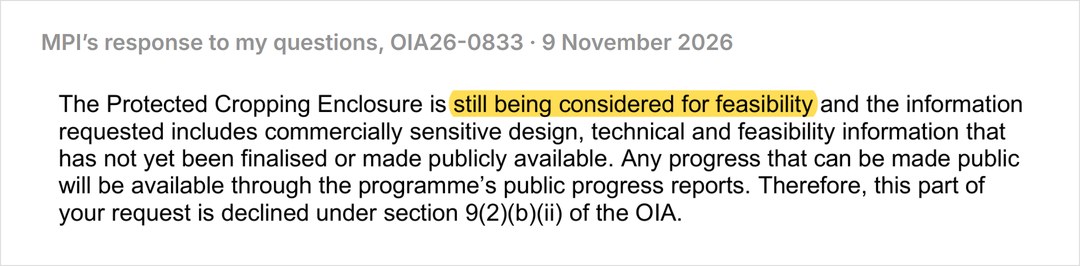 MPI's response to my questions, OIA26-0833, 9 November 2026
So the cost/benefit assessment was done more than a year ago, and about three years after the glasshouse was dropped, its replacement is still being considered for feasibility. MPI wouldn't release the assessment, or anything on the enclosure's current status. Yet the programme's annual plan for this year, the same Appendix One, lists "Implement Protected Cropping Enclosure (PCE) with living organic soil at Waihopai site" as a priority.
So the programme's biggest workstream was cut back to a cheaper option that its own review gave a "Low to moderate" chance of meeting its objectives. Three years on, MPI won't release the design, the cost/benefit assessment or the milestones. What is indoor cultivation's $4.84 million forecast paying for, if the enclosure is still at feasibility? And how is a "Low to moderate" chance "likely a favourable outcome" for the people paying for it?
What Puro told the council
MPI won't say where the enclosure's up to, but Marlborough District Council's public consent file for Waihopai fills in some of the gaps. It also shows how far Puro's glasshouse plans have shrunk:
- 2019: Puro's crowdfunding page said "We plan to build high-security greenhouses for growing medical cannabis" at Waihopai, and listed "greenhouses covering 10,000-30,000m2".
- October 2020: Puro's consent application for the site said "Ultimately Puro expect that by 2024, the total area of the proposed glasshouses will be 14,000 m2".
- 2022: the programme's plan was a "state-of-the-art 2000m2 pilot glasshouse".
- Late 2023: that was dropped for "a smaller plastic-skinned tunnel house".
- May 2026: the council recorded that "the tunnel houses" "have not yet been established on site".
- November 2026: MPI says the enclosure is "still being considered for feasibility".
In Puro's defence, the 2019 and 2020 numbers were its own plans from before this programme, and businesses are allowed to change their plans.
So why hasn't anything been built? In January the council reminded Puro that its consents for the site would lapse on 1 May. Two days before that date, Puro's planning consultant applied for more time, and this was the explanation.
The delays experienced have not been due to inaction. Rather, they reflect broader economic conditions, including elevated construction costs and market uncertainty, requiring project expansion to be carefully timed to ensure financial viability.
The letter also said "Glass / tunnel house technology is developing and changing constantly, and Puro are keeping a close watch on the best designs for their purpose", and that "additional propagation areas and associated large-scale heating infrastructure will be required within the next three years". The council gave Puro until May 2029.
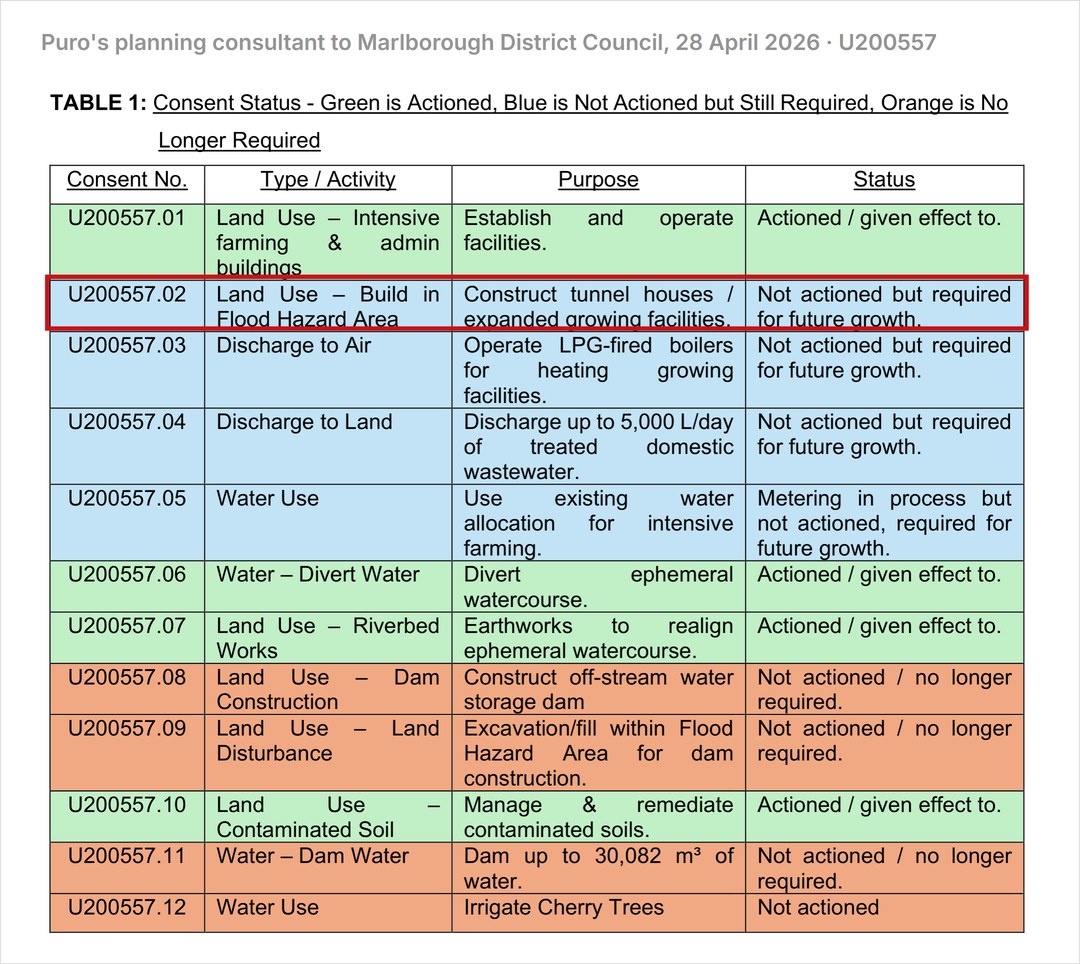 Puro's planning consultant to Marlborough District Council, 28 April 2026, consent U200557
That letter went in about six months after the programme's own report said "Structural drawings and resource consents will be completed" for the enclosure. The letter doesn't mention MPI, the programme or the enclosure at all, so it may not be talking about the same structure. But the council's public records show no new consent for an enclosure since then. So are the drawings done, or is Puro still keeping a close watch on the best designs?
There's another mismatch. The programme's indoor workstream was about "growing organic medicinal cannabis indoors", and its plan for the enclosure says "living organic soil". But the council's 2021 decision says Puro's operation "will consist of the use of glasshouses to hydroponically grow medicinal cannabis and hemp plants". The consultant's letter says the tunnel houses are "for hydroponic plant propagation", and it describes the site's "existing hydroponic research and propagation systems". Propagation isn't the whole crop, of course, and I'm no planner, so I can't say whether a consent for hydroponic glasshouses would cover a plastic tunnel full of living soil. But which is it going to be? Meanwhile, Puro's own product sheet says its flagship flower, Kākāriki Koha, is "Cultivated indoor at our Waihopai facility".
There's one more thing about Waihopai. Land records show a Puro subsidiary, Puro Land Limited, became the owner of Puro's 8 hectare Waihopai site on 7 May 2025, with a bank mortgage registered the same day. Property sales records put the price at $1 million, agreed in November 2022.
To be fair, this wasn't a simple case of Puro picking land over a glasshouse. Buying was the plan well before this programme. Puro's 2019 crowdfunding page described its Waihopai lease as "21 years plus right to purchase", and its 2020 consent application says it "currently leases the subject property" and had "a current sale and purchase agreement conditional on approval of this resource consent application". That deal changed shape, though. Nine days after the $1 million price was agreed, the whole 33.5 hectare block, Puro's site included, was transferred to a company owned by a neighbouring vineyard owner, and Puro's 8 hectares was split off in January 2025. The rest of the "Optional expansion: 33.5 ha" on Puro's 2019 page is now vineyard. Banks also lend against land more readily than against a glasshouse. But the glasshouse was dropped because "funding for the pilot greenhouse was not secured", and Puro still found a way to fund the land.
The land doesn't seem to be what's holding things up either. The covenant Puro signed with that neighbour when it took ownership says "Further development may occur to this facility in the future to expand business operations", and the neighbour agreed it "will not object to any structure being built or erected" for the facility. The only limit on building in it is a 3 metre height cap within 2 metres of the western boundary. Admittedly, most of the old block is in a flood hazard area, which could well be part of the feasibility question, although building there is what the extended consent is for.
So the land's bought, the neighbour's signed and the consent runs to 2029. Puro's explanation to the council is cost and market uncertainty. Why, 18 months after Puro took ownership, is the enclosure meant to go on that land still being considered for feasibility? MPI won't say. If you ask me, it says a lot that a council's public file tells taxpayers more about this than the ministry spending their money.
Still no jobs number
The programme's outcome logic model said "By 2026, creation of 200 FTE". In May, MPI told me the target "remains" but is delayed, and that it's "a measure in overall industry employment and should not be conflated with the cadetship programme".
Fair enough. So this time I asked for the documents showing how it's defined and measured, the latest figure, and any new target date. MPI didn't give a figure. It now calls 200 jobs a "long-term outcome", whose timeframe "has been delayed, reflecting the pace of industry development". Instead, it sent an updated logic model, Appendix Two, which it says "sets out the current outcomes and measures used to assess programme performance, including the employment outcome".
MPI's file name says the update was revised on 25 February 2026. Here it is next to the original.
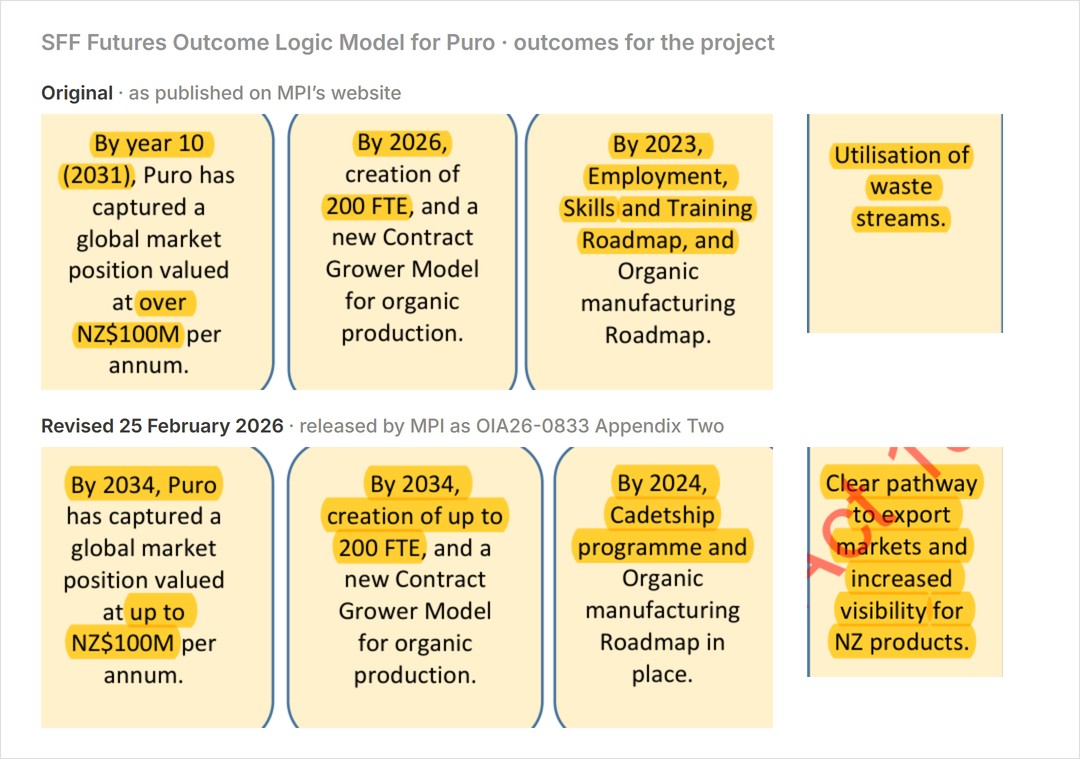 SFF Futures Outcome Logic Model for Puro, the original on MPI's website and the version released as OIA26-0833 Appendix Two
The jobs target has gone from "By 2026, creation of 200 FTE" to "By 2034, creation of up to 200 FTE". That's eight years later, well after even the extended programme is due to finish. And "up to" 200 isn't the same promise as 200.
It's not the only goalpost that's moved:
- Market position: "By year 10 (2031)", Puro was to have a market position "valued at over NZ$100M per annum". Now it's "By 2034", and "up to NZ$100M".
- Business model: "proven and has reached global scale" is now just "proven".
- Training: "By 2023, Employment, Skills and Training Roadmap" has become "By 2024, Cadetship programme". That's a 2024 target, written in 2026.
- Industry value: "$570m by 2026" is now "$552m by 2029".
- Waste: the outcome "Utilisation of waste streams." is gone. In its place is a "Clear pathway to export markets and increased visibility for NZ products."
The model still doesn't say how jobs are counted, or how many there are now. The only jobs number in the whole response is this one. "There were three cadets employed in field activities under Workstream 6 as at the end of year four."
To be clear, I'm not saying three cadets is the jobs figure. It's up from one in early 2024, according to the mid-term review, and that's real progress for the people involved. But it's the only number I've been given, and it isn't the one the programme promised. If you ask me, "up to" 200 jobs by 2034 is a ceiling, not a target, and it can't really be missed.
That council file has one more number. Puro's 2020 application expected staff at Waihopai to increase "through 2021-2024" to "a maximum of 100 full time equivalent staff". Its consultant's April 2026 letter says "4 research and propagation staff are employed full time" there. That's one site, not all of Puro, and the 2020 number came before this programme. But it's the only hard count I've found, and it's a long way from 100.
The self-assessment that wasn't done
The mid-term review recommended that the programme's governance group "conducts a self-assessment exercise". According to the review, that group includes an independent chair, two people from MPI, and two from Puro, its CEO and its main shareholder.
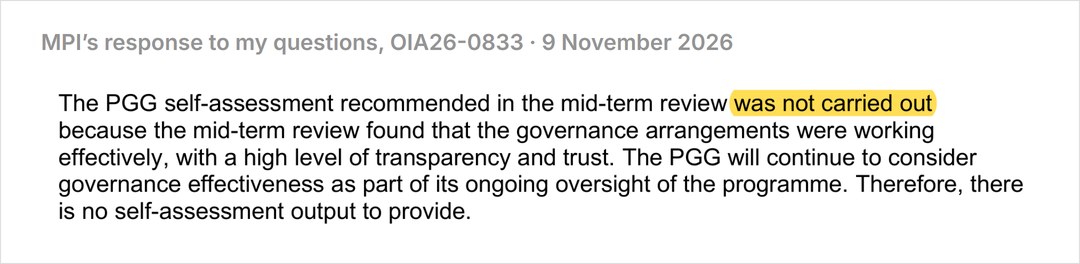 MPI's response to my questions, OIA26-0833, 9 November 2026
MPI says the group "will continue to consider governance effectiveness as part of its ongoing oversight of the programme". To be fair, the review didn't expect much from a self-assessment. It said "the gains from such an exercise are not expected to be substantial". But it recommended one anyway, because "it represents best practice in governance and could lead to small improvements in oversight, decision-making, and accountability".
If you ask me, that makes MPI's reason circular. The review already knew governance was working when it recommended the check, so governance working well was never a reason to skip it.
The checks I counted in Puro's favour
In my last post I counted two things in Puro's favour, both from MPI's May answer. The programme had had "a full external financial audit", and it would get a final independent evaluation. Here's what I've learned about both.
- The audit is withheld in full. MPI says it was completed in 2024, and repeats an earlier OIA answer (OIA26-0354). The audit "rated three out of four areas within scope as 'minor'", one area "was rated as 'moderate'", and the recommendations "have been addressed to MPI's satisfaction". I can't check any of that, or what the four areas were, because the report is withheld.
- The final evaluation "has not taken place as the programme has not ended yet, nor has it been planned or scoped at this stage". In May, MPI said the programme "will be subject to a final independent evaluation upon completion". The programme's been extended by two years, so there's time, but I'll be keeping an eye on it.
So here's the scorecard after two rounds of questions.
- In Puro's favour: the real outputs I listed last time, three cadets employed, and MPI's promise of a public handbook. Maybe the audit too, if anyone could check it.
- Still unanswered: what the funding agreement says the public gets back, what the business case promised, the current milestones, what the audit found, the spending on each workstream, the jobs figure, whether there's a confidential handbook and who it's for, the Stop/Go decisions, the confidential review, the enclosure plans, and the 2022 draft.
That's three, maybe four, against eleven.
Where the money's going
In May, MPI told me "the programme has allocated funding to market access activities within its approved scope", and that they're intended to "complement longer-term domestic supply chain and infrastructure investments, rather than replacing them". This time it said when, and what for. The governance group "approved activities to support the development of New Zealand's medical cannabis industry in year four". MPI says "These are focused on addressing market access barriers, increasing international engagement, and gather market intelligence to inform future industry growth."
MPI didn't say which markets, and Appendix One doesn't either. But it shows market access is now a workstream of its own, "Workstream 4B: Market Access", and its first priority for this year is to "Increase conference attendance and international visits for clinicians and industry partners". In my last post I said the programme's direction has followed the exports. Now it's written into the plan, and the updated logic model points the same way, with export markets where waste used to be.
So more conferences and international visits are on the programme's list. But MPI says travel and event spending is "managed as part of the overall workstream delivery costs" and is "not held by MPI but by Puro, which is not subject to the OIA". As I read it, travel is part of the programme's costs, but MPI doesn't hold the figures. So MPI couldn't tell me what, if anything, the programme paid towards the trip in Puro's July 2026 report, where "The Senior Leadership Team travelled to the UK for the product launch with IPS Pharma, and presented at Cannabis Europa as part of the NZ contingent." That trip was listed under "Key highlights and achievements".
"Commercially sensitive"
Here's what MPI decided the public can't see:
- The funding agreement, including its terms on intellectual property and sharing results. Those are the terms that say what the public gets back for its money.
- The business case, and MPI's own assessment and decision documents.
- The current annual plan and milestone schedule.
- Spending by workstream, even going back to 2022.
- The audit.
- The governance group's Stop/Go decisions.
- The confidential version of the mid-term review.
- The enclosure's cost/benefit assessment and current status.
- Every draft of the handbook.
Commercial sensitivity is a real thing, and some of this probably does need protecting. But MPI's assessment of whether to spend $13 million of public money is MPI's own document, and any Puro figures in it could be blacked out. And if you ask me, spending by workstream can't be that sensitive when the original and forecast budget for every workstream is already public, in the mid-term review on MPI's own website.
That's why my request asked MPI to release documents with the sensitive parts deleted, and to summarise anything it withheld in full and list it with the reason. MPI gave a few short summaries in its own words. But apart from the two appendices, a one-page excerpt and the updated logic model, it didn't release a single document, redacted or not, and it didn't list what it withheld.
Without a spending breakdown, the question I asked last time is still open. The programme's most expensive quarter so far was its very first, at $2.29 million, and its headline achievement was a harvest that was already in the ground when the funding was announced. Were the costs of growing that crop counted as programme spending? MPI won't release the numbers that would answer it.
The public interest got one sentence.
MPI is satisfied that, in the circumstances of this case, the withholding of the information is not outweighed by other considerations which render it desirable in the public interest to make the information available.
Why this matters
This is public money. MPI has committed $13 million of it to this programme, and when I asked what it's bought, nearly everything came back "commercially sensitive". Taxpayers can't see the agreement, where the money's gone, the audit, or a single page of the handbook they're paying for.
From what I've seen, Puro looks like it's being kept alive by this programme. I'll back that up next week with Puro's own figures. If that's right, the public isn't so much funding research as funding a business.
And the research it was sold on has lost most of its point. The handbook was meant to be the public's return, a guide to growing organic medicinal cannabis at scale. By the time it's out, New Zealand's medicinal cannabis scheme will have been running for nearly eight years, and growers like the ones we work with at Chill Division have already worked out how to get licensed and get product to market without it.
I'm not convinced the market even wants what the handbook is about. Puro's COO told Marlborough Now that demand for organic cannabis is "very strong", but in the same breath said Puro "might not have necessarily been getting a price difference" for it. From where I sit, what buyers and patients actually need is flower that's clean, consistent and passes microbial testing, and that comes far more reliably from an indoor, closed environment than from an open field. The programme's own mid-term review says irradiation, "which is prohibited in organic certification", is "often necessary for meeting pharmaceutical standards".
To be clear, that's about flower grown outdoors, in greenhouses or in protected cropping enclosures, where the crop is open to the weather and whatever comes in with it. Chill Division doesn't use irradiation. The flower we grow is indoors, in a closed environment, and it doesn't need it.
So is $13 million of public money good value for a growing guide that's years late, for a kind of growing even Puro says hasn't necessarily earned a better price, from a company that might not be here without it? If you ask me, no.
What's next
MPI sent the two appendices the same day I asked. I've also asked it for decisions on the parts of my request it didn't address, and for a copy of its earlier answer on the audit, OIA26-0354. I'd rather sort these out with MPI directly, but the Ombudsman is an option if that doesn't work.
If MPI or Puro think I've got any of this wrong, I'll correct it.
Sources
- MPI, 9 November 2026, OIA26-0833, MPI's response to my request (PDF, 240 KB).
- MPI, 9 November 2026, OIA26-0833 Appendix One (PDF, 825 KB): the programme's year five priorities, from its 2026/27 annual plan.
- MPI, 9 November 2026, OIA26-0833 Appendix Two (PDF, 727 KB): the outcome logic model, revised 25 February 2026.
- MPI, 5 May 2026, OIA26-0278, MPI's response to my complaint (PDF, 350 KB).
- Beehive, 8 April 2022, Govt helps fast-track organic medicinal cannabis industry: the Minister's announcement.
- Peak Projects NZ, October 2024, Puro mid-term programme review: workstream budgets, the glasshouse change, cadets, the governance group, the self-assessment recommendation, and irradiation and organic certification (page 50).
- Marlborough Now, 22 November 2025, Pure and Simple: Puro's COO on demand for organic cannabis, and price.
- Chill Division, cultivation SOPs, free since October 2026.
- MPI, SFF Futures Outcome Logic Model for Puro.
- Progress reports quoted: July 2022, October 2022, July 2025, October 2025, December 2025, July 2026.
- MPI, as at February 2022, SFF Futures co-investment requirements (archived copy): MPI's maximum share for commercial proposals.
- MPI, September 2022, SFF Futures guidelines for applicants (archived copy), page 12: the rules on intellectual property.
- Marlborough District Council, consent file U200557: Puro's October 2020 application, the May 2021 decision, the January 2026 lapse reminder, the consultant's 28 April 2026 letter and the May 2026 extension. As at 9 November 2026, the council's resource consent and building consent open data showed no consent at the site mentioning an enclosure, greenhouse or tunnel house.
- Marlborough District Council, consent file U240297: the 2024 subdivision of the block, and the vineyard on the rest of it.
- LINZ, 9 November 2026, Record of Title 721569 (Lot 1 DP 493954), historical search: the 33.5 hectare block, its transfer on 9 December 2022 and its split on 23 January 2025.
- LINZ, 9 November 2026, Record of Title 1213337 (Lot 2 DP 608638), historical search: the transfer to Puro Land Limited and the mortgage, both 7 May 2025.
- LINZ, Covenant Instrument 13202452.4, registered May 2025: the covenant between Puro Land Limited and its neighbour.
- Companies Office, MPL 825 Limited: the company the block was transferred to, wholly owned by the neighbouring vineyard owner.
- CoreLogic, 825 Waihopai Valley Road on propertyvalue.co.nz: the $1 million sale, agreed 30 November 2022 and settled 7 May 2025.
- Companies Office, Puro Land Limited: wholly owned by Puro New Zealand Limited.
- Puro, 2019, PledgeMe wholesale offer: the Waihopai greenhouse plans and lease, "21 years plus right to purchase".
- Puro, March 2025, Kākāriki Koha product sheet (PDF): where it's grown.
- Puro, FAQ, as at 9 November 2026.
- Rural News, 25 March 2026, Puro seeks contract growers as medicinal cannabis demand surges: the Zespri-style contract growing plan.
- Field Notes, 19 October 2026, Why are taxpayers funding Puro to do what Puro says can't be done?