
Why are taxpayers funding Puro to do what Puro says can't be done?
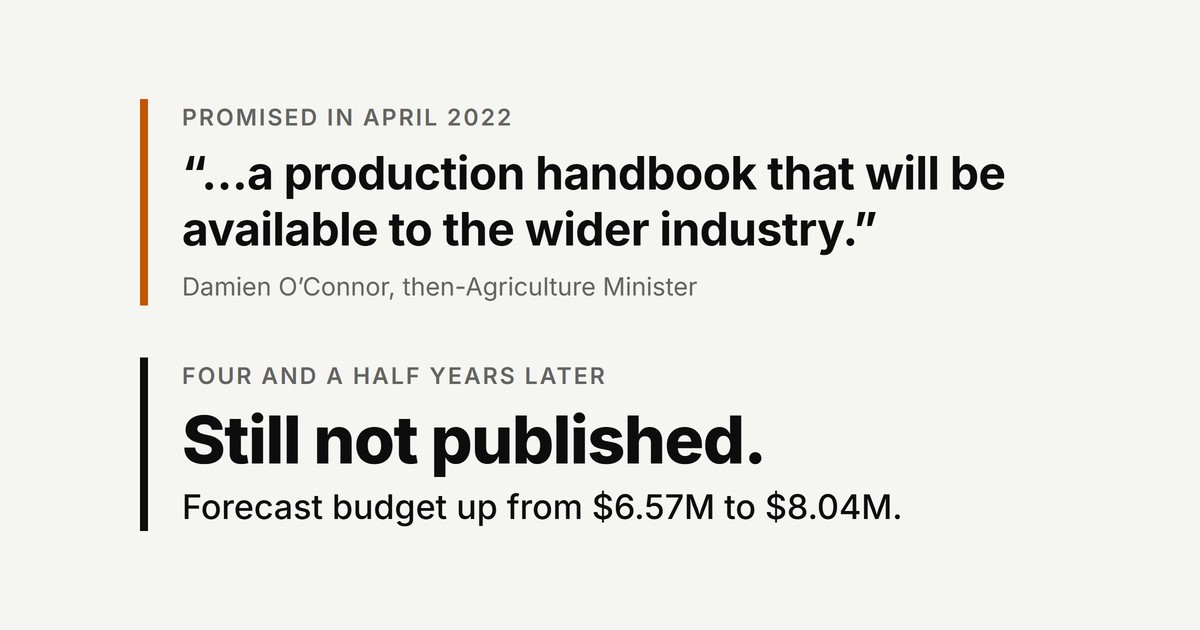
Back in April 2022, the Government announced a $32.2 million partnership with Puro, New Zealand's biggest medicinal cannabis grower. MPI put in $13 million through its Sustainable Food and Fibre Futures (SFF Futures) fund, and Puro funded the rest.
The pitch from then-Agriculture Minister Damien O'Connor was big:
- the industry could "follow in the footsteps of our wine industry"
- it would mean "domestically sourced medicinal cannabis for Kiwi patients in pain"
- Puro would write a production handbook "available to the wider industry", which he called "a comprehensive blueprint that other Kiwi companies can use to follow in Puro's footsteps."
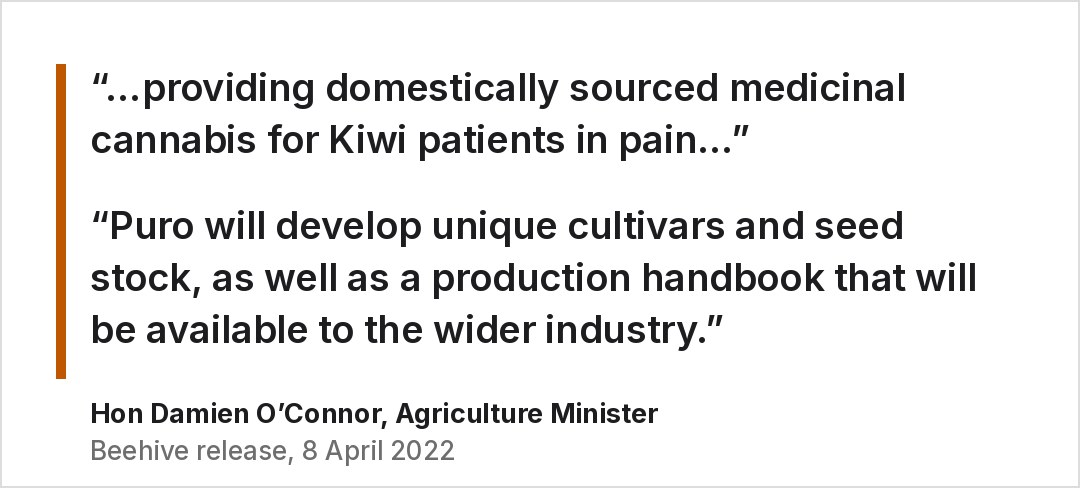 Beehive release, 8 April 2022
Four and a half years later, the company we're co-funding to deliver "domestically sourced medicinal cannabis for Kiwi patients" says it's blocked from doing exactly that, and its flower goes overseas instead. Meanwhile, other New Zealand growers, my own tiny one included, are getting NZ-grown flower to NZ patients under the same rules. So why are we still paying for it?
Then there's the handbook, the bit I was most interested in. It was meant to be the headline benefit for New Zealand from the Government's investment, and it's now the single biggest line in the budget.
So I read everything MPI has published about the programme. That's all 17 quarterly progress reports, the 2024 independent mid-term review (MTR), and the programme's outcome logic model. I also trawled through the information that MPI provided as written answers to the questions I sent them in April. Everything quoted below is word for word from those documents, and the sources are at the bottom.
Usual disclosure applies. I help people get licensed, and through Pause Labs and Chill Division I've got NZ-grown flower on the market here. I'm not a neutral party, which is exactly why everything below is sourced. You should also know that in April, once Puro's executive chairman Tim Aldridge was made aware of my complaint to MPI, he lodged a complaint about me the following week with the NZ Medicinal Cannabis Council (NZMCC). If you ask me, it was a retaliatory complaint, plain and simple. I stepped down from the NZMCC when it came through.
Credit where it's due, too. As I wrote in September, Puro's export numbers are genuinely impressive. This isn't about whether Puro can grow. It's about what the public paid for. It's also about the rampant misinformation being spread about why they haven't got product to market locally, as they insult the rest of the industry and tar us all with their brush of incompetence.
Promised vs. on the record
| Promised (2022) | On the record (2026) |
|---|---|
| A production handbook "available to the wider industry" | Not published. A "detailed draft" was reported in October 2022. MPI says a confidential version is being developed for Puro. |
| A 2,000 m² pilot glasshouse for year-round, pharmaceutical-grade growing | Never built. Replaced by a plastic tunnel house. A smaller replacement enclosure hasn't been built either. |
| "By 2026, creation of 200 FTE" | No jobs figure in any public report. MPI says the timeline "has been delayed". |
| A five-year programme, 2022 to 2027 | Now seven years. |
| Medicine for "Kiwi patients in pain" | Puro says GMP rules block its flower from NZ patients, so it goes overseas. Other NZ growers are supplying NZ patients now. |
Paying for something they say can't be done
What we're paying for
The Minister sold this programme as "domestically sourced medicinal cannabis for Kiwi patients in pain", and Puro said it would "provide New Zealand patients with greater access to high quality, locally grown and manufactured medicine". The programme's own logic model promised that "New Zealanders have increased access to quality, trusted, affordable medicinal cannabis".
GMP, the manufacturing standard every medicine sold here has to meet, is written into the programme itself. The mid-term review describes the indoor cultivation work as "ensuring compliance with Good Agricultural and Collection Practice (GACP) and Good Manufacturing Practice (GMP) standards". After the glasshouse was dropped, the revised plan added "developing methods for GMP-compliant sterilisation and packaging, essential for producing pharmaceutical-grade products for export". That is the same capability that Puro needs to supply New Zealand.
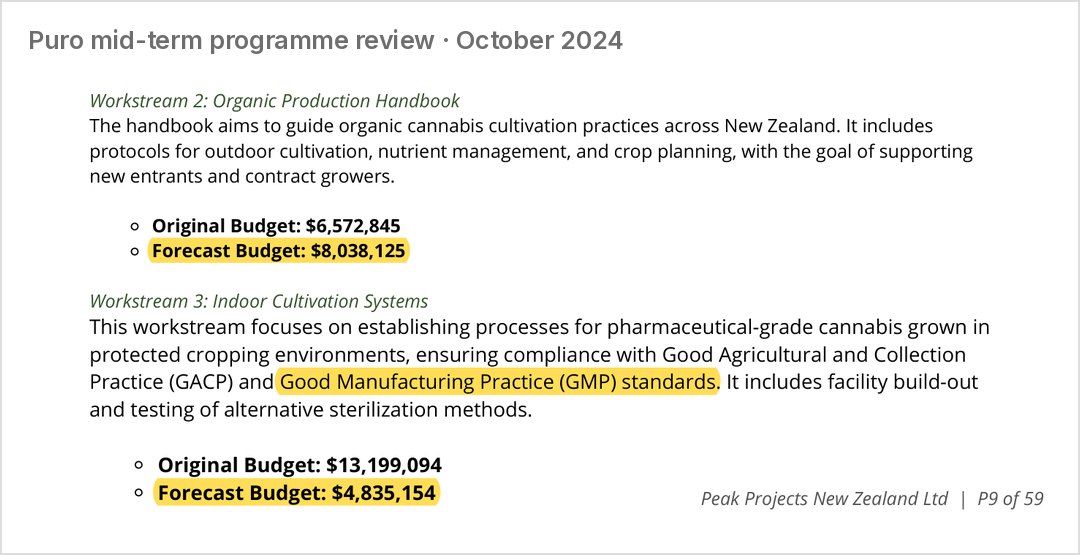 Puro mid-term programme review, October 2024, page 9
What Puro says
Puro's FAQ answers "Why can't I get Puro products prescribed in New Zealand?" by saying "no New Zealand manufacturer currently has regulatory approval to package our premium live dried flower, hash, and rosin". It says "supplying domestically requires the manufacturer to meet expensive GMP (Good Manufacturing Practice) standards", and "Until New Zealand's regulations change we will continue to focus on meeting the growing demand from global buyers."
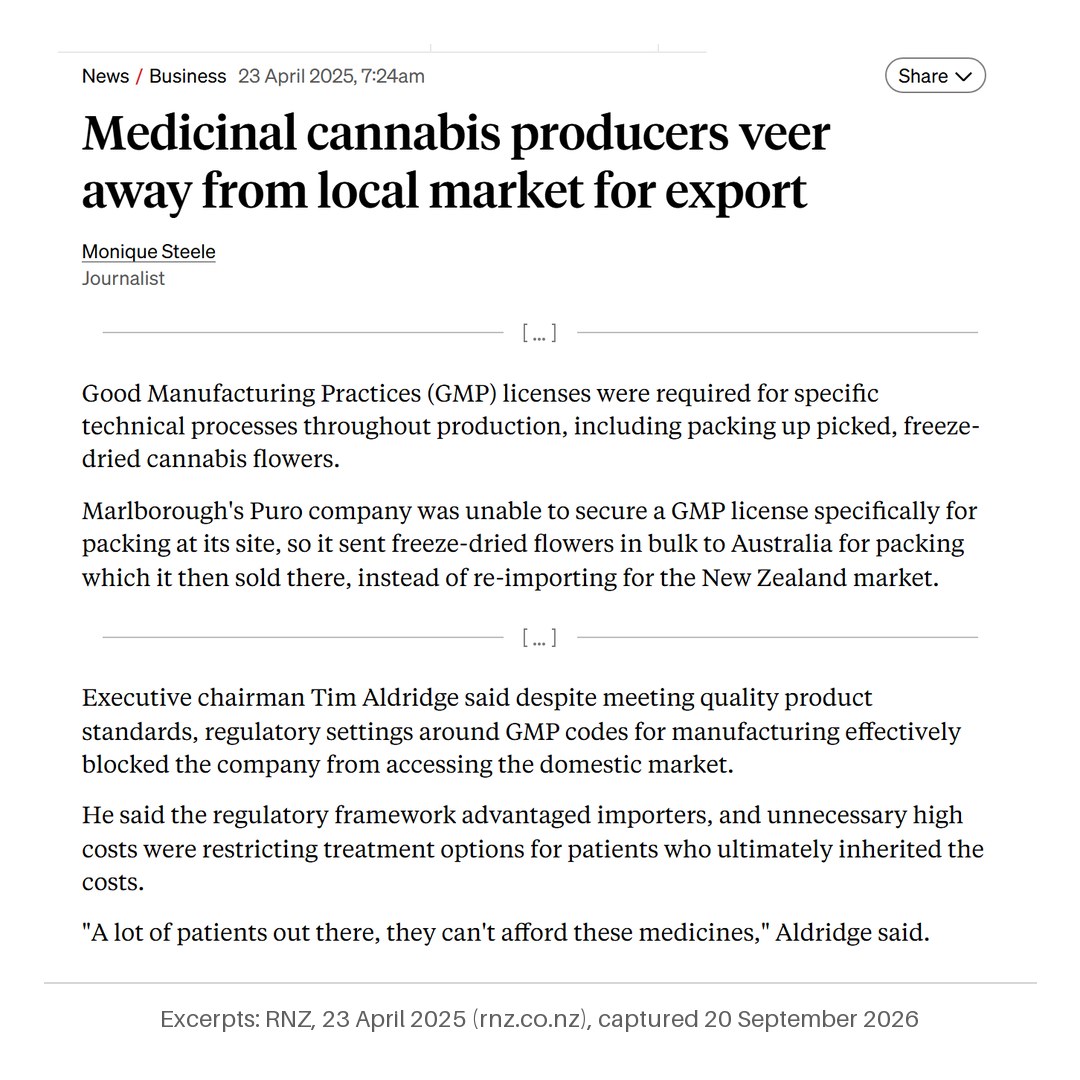
RNZ reported last year that Puro "was unable to secure a GMP license specifically for packing at its site, so it sent freeze-dried flowers in bulk to Australia for packing which it then sold there, instead of re-importing for the New Zealand market". Puro's executive chairman Tim Aldridge said GMP settings "effectively blocked the company from accessing the domestic market". We dispute this assertion, and the next few sections explain why.
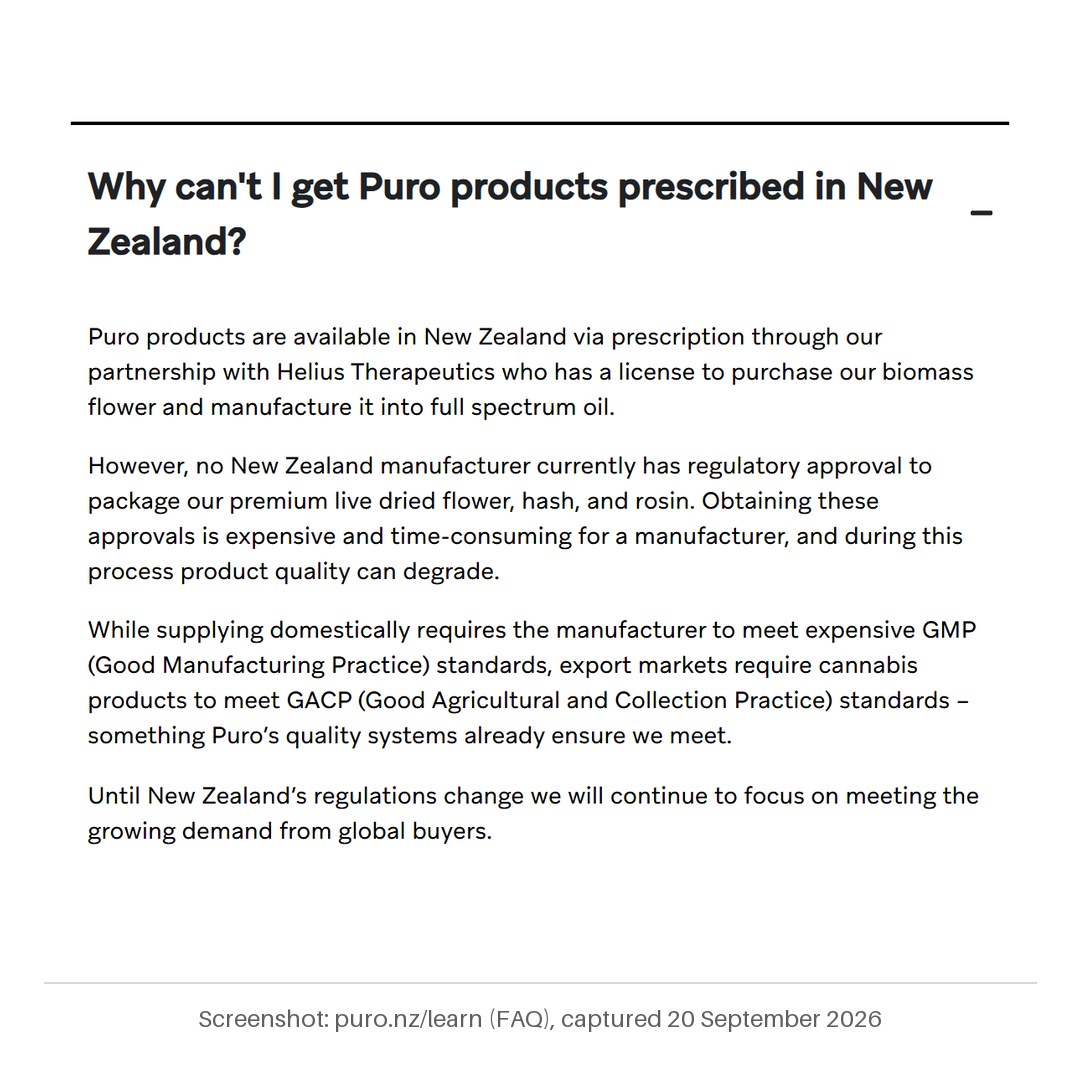
To be fair, there is one way Puro's crop reaches NZ patients. Helius bought its biomass and makes a CBD full-spectrum oil from it, under a deal for more than 10 tonnes over five years. Puro's FAQ counts that as "Puro medical cannabis", but it's a Helius product. And that deal was signed in January 2022, three months before this programme started. Puro's own flower, hash and rosin don't make it here.
Reading and seeing through the fine print
Look closely at what Puro's FAQ actually says. It doesn't say Puro can't get flower to New Zealand patients. It says no NZ manufacturer can package "our premium live dried flower, hash, and rosin".
"Live dried" is Puro's own format. Their flower is flash-frozen at harvest, then freeze-dried. Conventionally dried flower is a different story. NZ GMP manufacturers already pack conventionally dried flower. After all, that's exactly how mine gets to pharmacies! Puro's last harvest was its biggest ever, at more than 65,000 plants, and the FAQ never explains why none of it could be dried the conventional way for New Zealand patients. Puro will say live drying makes a better product, and maybe it does. But a better product nobody here can buy doesn't help patients here.
Here's what really grinds my gears though. The public helped pay for the format Puro now says can't be packed here. The programme's own reports track it, from "A novel drying system has been qualified and procured" (March 2024) to "Technology for live dry flower has been trialled successfully" (October 2024) to "A commercial-scale freeze-drying unit was installed and commissioned" (July 2025). Rural News put it plainly, reporting that "With research support from the Ministry of Primary Industries the company has pioneered 'live drying' technology".
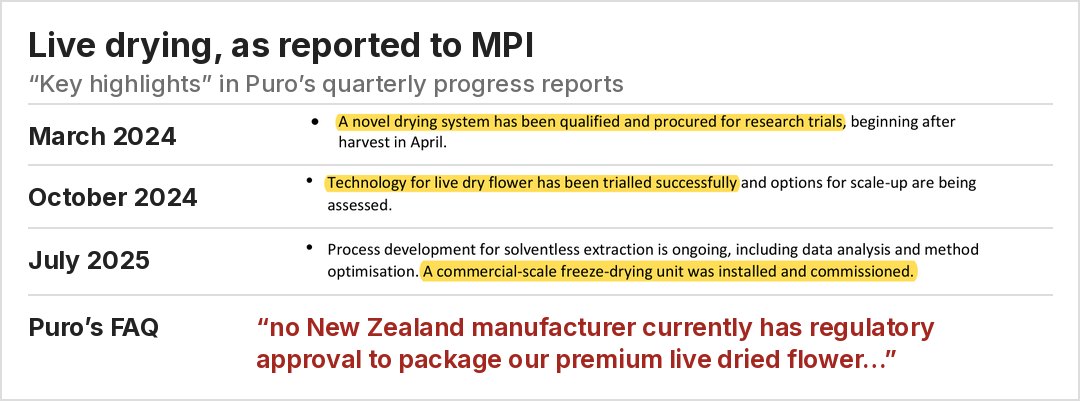 Puro's quarterly progress reports to MPI, March 2024 to July 2025, and Puro's FAQ
And even live-dried flower isn't stuck. Puro can pay one of the existing NZ GMP manufacturers to validate the rehydration process for its live-dried flower. It's the same kind of process validation I did with Helius for mine, which I described in September. This isn't difficult. It's just some hard work, time, and a bit of money. That's exactly the kind of thing a $32.2 million programme with GMP written into its scope exists to pay for. In my view, the FAQ is carefully worded to make a product choice look like a regulatory ban.
So which is it?
That leaves the public in an odd spot. GMP compliance is part of the programme we're co-funding, and it's the exact thing Puro says stops it supplying New Zealand.
Either the programme can solve it, in which case why hasn't it, four and a half years and $18.6 million in? Or Puro doesn't think it can be solved, in which case what is the domestic half of this money actually buying?
Other people have product on the market. Why can't Puro?
Other New Zealand growers are doing what Puro says can't be done.
My own flower is grown by Pause Labs, the smallest cultivator in the country, at about 19 m². It goes through its GMP steps at Helius, was verified by the Medicinal Cannabis Agency in December 2025, and was in pharmacies by February. Eqalis has flower products of its own, Health House has taken a flower product through the same registration process, and NUBU has NZ-grown flower from both Kalyx and Organic Greenz Group (OGG) packed in Australia and brought back for NZ patients. I went through how all of that works in September.
When Cannasouth needed GMP, it went and got it. In May 2023 it merged with GMP manufacturer Eqalis, raising about $7.2 million to make the deal happen. That same month it got its own licence to manufacture dried flower at its cultivation site, giving it end-to-end GMP, from flower to finished medicine, in-house, just like Puro could.
Puro is the country's biggest grower. Its programme has a $32.2 million budget, $13 million of it public money, and GMP is written into its scope. Why couldn't it do something similar? Or simply contract an existing GMP facility, the way I did?
In my view, if Puro genuinely believes supplying New Zealand is impossible, it shouldn't be taking public money for a programme sold on doing it. And if it isn't impossible, which plenty of us have shown, the programme should either be delivering it, or MPI should stop funding it.
What doesn't add up
1. The handbook that's always nearly finished
Here's the handbook's own timeline, from the progress reports:
- October 2022: "Detailed draft of Organic Production Handbook was completed." The programme had spent $2.86 million by then.
- April 2023: a technical writer is hired, and the next step is to "initiate content development".
- 2024 and 2025: chapters are drafted, then the content is "restructured" (January 2025). "Additional Chapters… will be drafted" is the next step three quarters running.
- December 2025: "final stages of development".
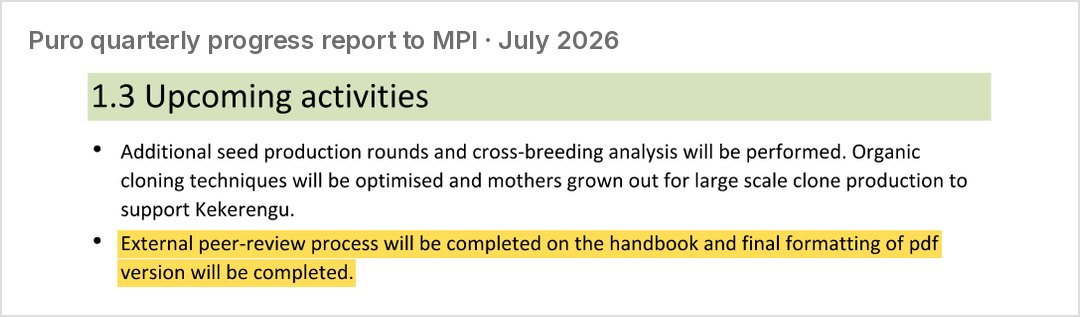
- July 2026: graphics done "in preparation for publication design", with a newly added "external peer-review process" still to come.
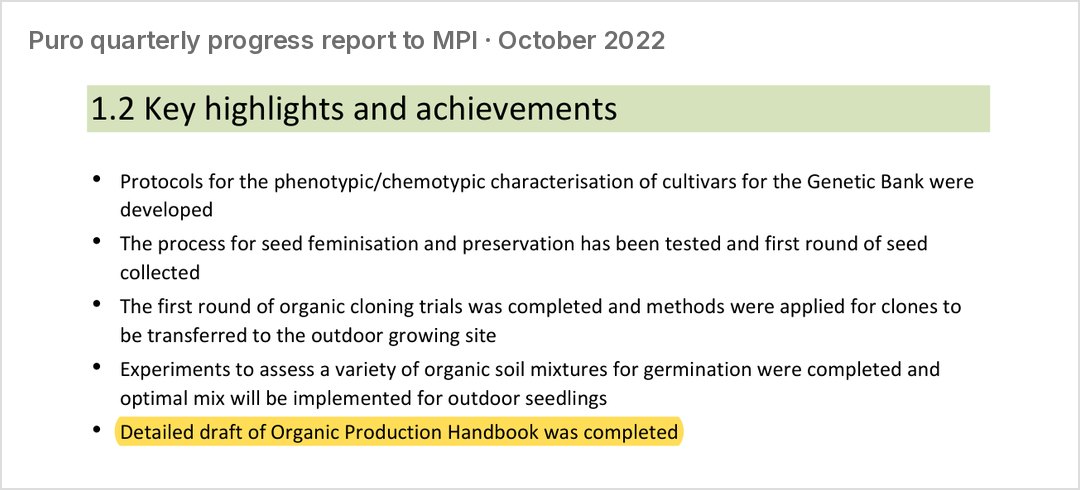
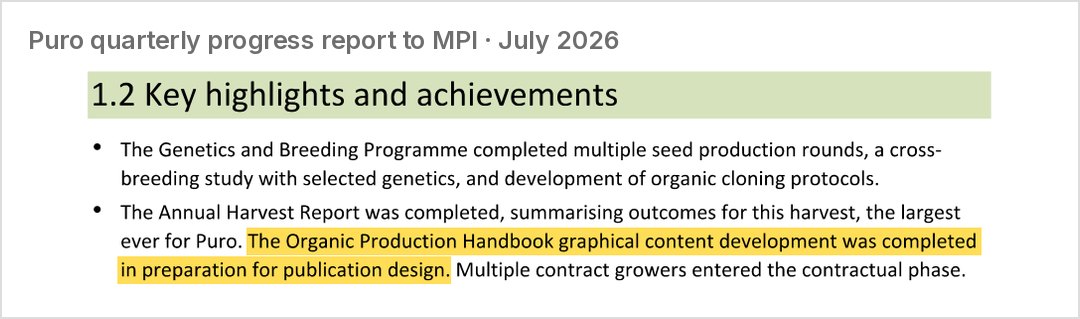
That's the official version. What I was told was different. In September 2023, nearly a year after that "detailed draft", Puro's co-founder and cultivation director, who leads the handbook work, told me one chapter, on site selection, was done and the next was half written. He also said the handbook came after sales and cultivation on his list, and that those two jobs took up more hours than he had. So the person leading what's now an $8 million workstream had it third on his list, behind Puro's own sales and cultivation.
That fits the October 2022 report itself. Its summary says it was the "detailed outline" that had been completed, even though its highlights call it a "detailed draft". Over the following year, the official reports said "Additional Chapters for the Organic Production Handbook have been drafted" (January 2024), then "additional chapter drafts have been completed and submitted to the Industry Advisory Committee" (October 2024). The mid-term review went further, saying "Key chapters on soil management, crop planning, and pest control have been completed".
Pest management is the clearest example of the handbook going round in circles. The October 2022 report said "the first draft of the Integrated Pest and Disease Management (IPDM) Plan under organic protocols" had been completed. The next report listed "Drafting of the Integrated Pest and Disease Management (IPDM) Plan" as a highlight all over again. Then in December 2024, he asked me to introduce him to other licence holders who'd grown outdoors. In his email to one of them, he wrote that "part of the industry handbook we are publishing will cover IPDM", and asked "what are your top 3 most frustrating pests/diseases?" He wanted the information to be relevant beyond Puro's own site, which is fair enough. But that was two years after the first draft was reported complete, and two months after the mid-term review said the pest control chapter was done. In January 2025, the report was still listing "additional chapter drafts on nutrient management and pest and disease management".
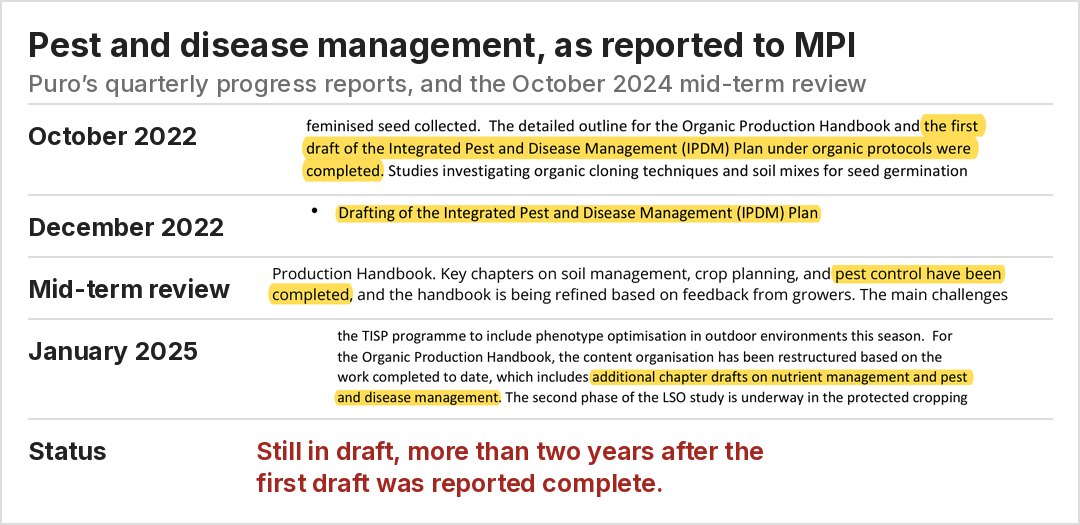 Puro's quarterly progress reports to MPI, October 2022 to January 2025, and the October 2024 mid-term review
So the wider industry was being asked to contribute to the handbook's pest management section, for a handbook that's now going to be partly confidential.
At the same time, the MTR shows a budget blowout for the handbook, increasing from $6.57 million to $8.04 million! The handbook is now the most expensive part of the programme, costing more than the breeding and indoor cultivation work combined.
Just to reiterate, an $8 million handbook that was reported as a detailed draft four years ago is still not released.
Look at what that money is for. The MTR describes the handbook like this. "The handbook aims to guide organic cannabis cultivation practices across New Zealand. It includes protocols for outdoor cultivation, nutrient management, and crop planning, with the goal of supporting new entrants and contract growers."
That's a growing guide. In what world did anybody think $6.5 million was a sensible budget for a growing guide, or even a necessary one? And then its forecast went up by another $1.47 million (public and Puro money combined), while it was still unpublished, two years after a "detailed draft" was reported as complete.
Puro may say the budget also pays for the field trials behind the handbook. Maybe it does? Maybe it could have been done on a 10% pilot scale? The real problem is that nobody outside the programme can tell, because the spending has never been broken down publicly. That's a serious value-for-money question, and the spending breakdown is one of the things I've asked MPI for in my latest OIA request.
For comparison, earlier this month I released our own SOPs for free. That's 129 pages covering security, cultivation and automation, the SOPs a licence application needs, in the versions the Medicinal Cannabis Agency has reviewed. They've already been used at over a dozen and a half licensed locations. I wrote them as a one-man band, it didn't take five years, and it didn't cost the taxpayer a cent.
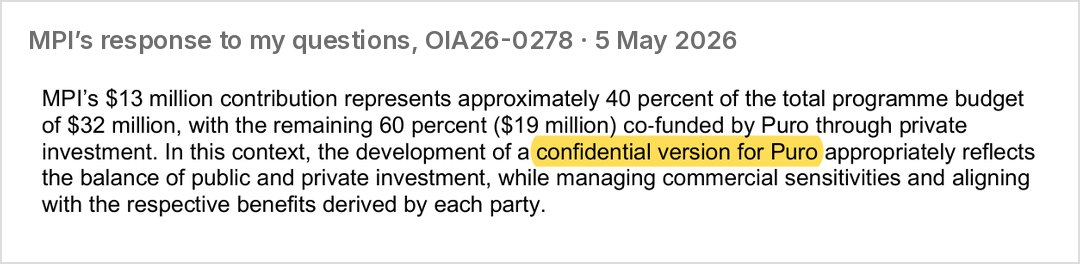
In May, MPI told me two new things. The handbook's timing "has been adjusted in line with the programme extension". And a confidential version is being developed for Puro.
2. The glasshouse that never was
Indoor cultivation was ironically the biggest slice of the pie at the start, making up $13.2 million (over 40% of the total budget). It was built around "a state-of-the-art 2000m² pilot glasshouse" for year-round growing. In late 2023 it was dropped after, in the review's words, "funding for the pilot greenhouse was not secured".
The budget was cut by 63%, to $4.84 million, and the work moved to a plastic tunnel house. The review says that manages "only one crop per annum (versus up to three in a high-tech greenhouse)", with "a greater risk of disease and microbial loading". It rated the chance of meeting even the revised goals as "low to moderate".
Then a smaller "prototype protected cropping enclosure" at Puro's Waihopai site magically appeared in the plans:
- July 2025: plans "will be implemented".
- October 2025: "Structural drawings and resource consents will be completed."
- December 2025: the enclosure is "to be constructed".
- April 2026: "Preparation for implementation… will commence."
- May 2026: MPI told me the programme "is progressing an option".
- July 2026: the progress report doesn't mention the enclosure at all.
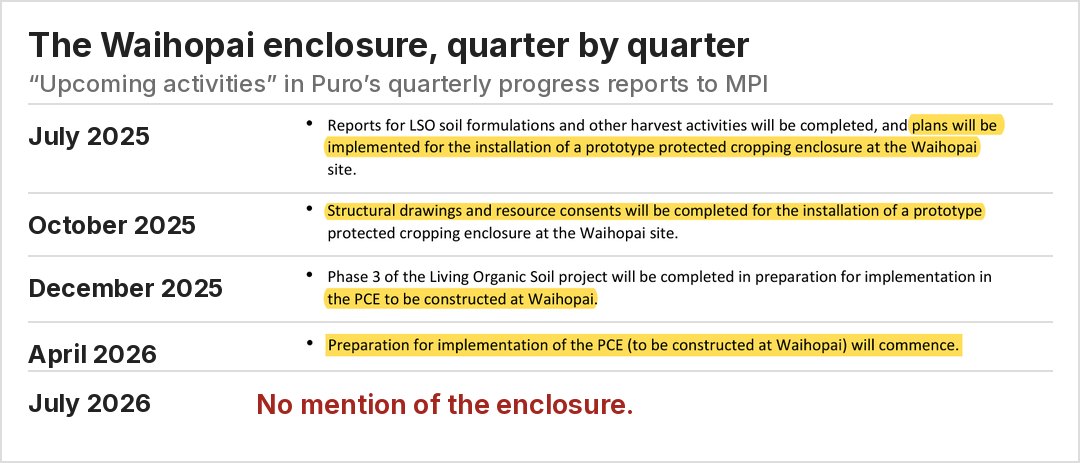 Puro's quarterly progress reports to MPI, July 2025 to July 2026
3. 200 jobs, and nobody counting
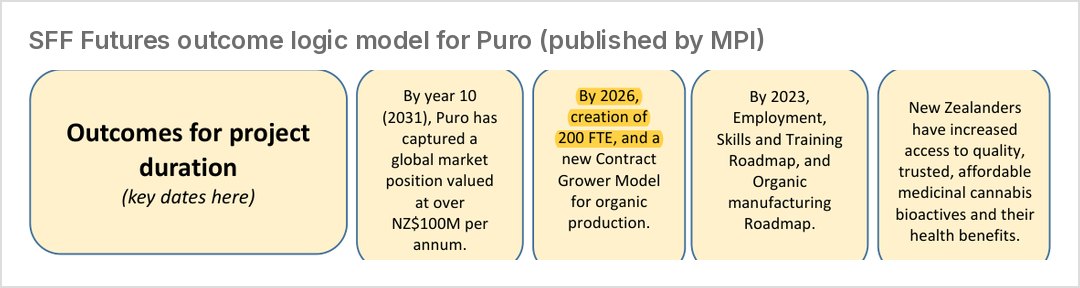
The programme's outcome logic model is VERY specific. "By 2026, creation of 200 FTE." It's now late 2026, and none of the 17 progress reports gives a single jobs figure.
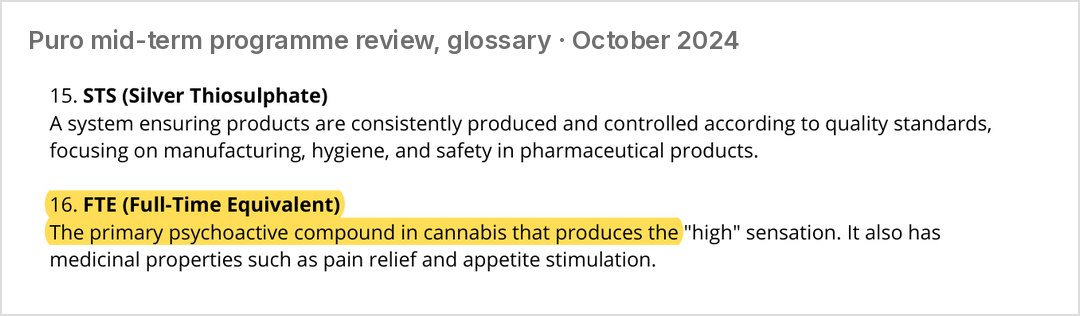
The mid-term review never mentions the target. "FTE" appears only once, in its glossary, defined as "The primary psychoactive compound in cannabis". That's an obvious editing error, but it is the review's only mention of FTE.
The number has also moved:
- 2020: Puro said its operation could create "up to 375 full time jobs within the next two years".
- 2022: the logic model said 200 FTE by 2026.
- 2023: a regional workforce plan, citing Puro's modelling, put 200 jobs "over the next 5-10 years".
The workstream for employment and skills started with $100,000. Its 2023 roadmap was "eliminated", and the only employment outcome itemised in the reports is a cadetship, which stops appearing after April 2025. Puro's COO Winston Macfarlane said in an interview with Marlborough Now last November that the harvest crew would grow from "45 odd part-time staff" to 150. Those are real jobs, for sure. However, they're seasonal and part-time, not the 200 FTE that were promised.
MPI's answer to me was that "The target to create 200 high-value jobs remains, however, the timeline for achievement has been delayed." MPI added that this is "a measure in overall industry employment". If you ask me, that's them dodging a bullet and making a very different and much easier claim they can tick off as achieved. It's NOT the outcome that Puro originally promised, nor what was sold to the general public as part of Puro receiving the taxpayers' funds.

4. More time to spend the money
The programme was meant to run from 2022 to 2027. It's now been extended to run for seven years.
By the end of its fourth year, 80% of the way through the original timeline, it had spent 51% of its budget. MPI told me that "reflects the proportionate level of activities completed and indicates a deliberate and prudent approach". The review that recommended extending the timeline was open about part of the reason, saying "A 3-year extension would permit better alignment with the original budget."
Underspending isn't waste. But if spending tracks activity, as MPI says, then the spending gap is also a delivery gap.
5. A light-touch review
The 2024 mid-term review by Peak Projects NZ is the main independent check so far.
- Its terms of reference put "Financial management" out of scope, yet it concluded that "The financials are managed prudently." Which one is it?
- The governance group that agreed the review team includes two representatives from Puro (its CEO and main shareholder), alongside an independent chair and MPI.
- It gave the handbook two stars out of five while its text called it "on track".
- Its glossary defines MBIE as "A stage in the cannabis breeding programme".
None of this is direct evidence of any wrongdoing by Puro, although there are some pretty damning parts to the report. There's almost no assurance for the public that any of the funding that has been spent, or will be spent, is going to be money well used.
6. Where the recent effort is going
The latest reports highlight:
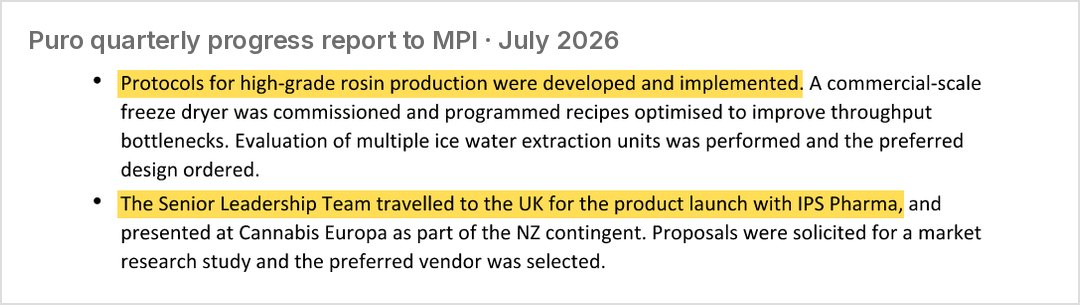
- Protocols for high-grade rosin and hash
- A commercial-scale freeze dryer
- A new ice-water extraction unit
- A branding study
- A leadership trip to the UK "for the product launch with IPS Pharma", which has been reported as a $16 million supply deal
 Puro quarterly progress report to MPI, July 2026
Some of that may well be legitimate research. However, the public reports don't separate the funded programme work from Puro's commercial operations, so a taxpayer can't tell which is which.
That question goes right back to day one. The programme's most expensive quarter so far was its very first, at $2.29 million, $914,008 of it from MPI. Its headline achievement was the "Successful harvest of nearly 50,000 plants at the organic Kekerengu facility". That crop was already in the ground when the grant was announced, with RNZ reporting the harvest kicking off the same day. Were the costs of a crop planted before the programme even began counted as programme spending?
Why this matters to taxpayers
The deal was public money, in exchange for public-good outputs. New Zealand was to get a blueprint for the industry, 200 full-time regional jobs, a proven indoor growing system, and medicine for New Zealand patients. We've not gotten anywhere near that.
And the money is still flowing. MPI's share for April to June 2026 alone was $856,442.
MPI's case for a confidential handbook is that its $13 million is "approximately 40 percent" of the budget, so a confidential version "appropriately reflects the balance of public and private investment". I don't think that holds up. The handbook was the public's share of the bargain. The Minister didn't announce a partial blueprint, and the programme's own logic model promised an "open-source agronomic farming system".
 MPI's response to my questions, OIA26-0278, 5 May 2026
There are also gaps in the reporting:
- No public breakdown of spending by workstream.
- No jobs figure.
- No delivery date for the handbook.
- From 2024, the quarterly reports stopped printing a running total of spending.
I can't tell you whether the money is well spent, or not. That's a big part of the problem.
Why this matters to patients
This programme (and the millions in funding for it) was sold as "domestically sourced medicinal cannabis for Kiwi patients in pain". Its logic model promised that "New Zealanders have increased access to quality, trusted, affordable medicinal cannabis", and "reduced costs for NZ medical cannabis manufacturers".
None of the public reports measures any of that.
Puro's executive chairman also told RNZ last year that "A lot of patients out there, they can't afford these medicines." I agree. That's exactly why the domestic promise mattered, and why it matters that the company we're co-funding to keep that promise now says it can't. NZ-grown flower is reaching NZ patients through GMP partners right now. Just not Puro's. The issue with NZ-grown flower is not GMP, the issue is Puro.
The programme's direction has followed the exports. The mid-term review's headline recommendation was a market-access push into Australia, and the latest highlight is a UK product launch. Exporting isn't wrong, and it brings money into the country. But it isn't what patients here were told $13 million of public money was for, and Puro doesn't need public money to export, as the others who are exporting show.
The handbook is the part that may actually help industry here, if it delivered what it set out to. But as I mentioned above, our own free SOPs already cover a lot of that ground, and they didn't cost us millions to make. The handbook may well largely be redundant at this point.
More New Zealand growers producing compliant, consistent flower is still the most direct route to more local supply and better prices for patients. Yet the handbook is the deliverable that's been delayed the longest, and it's now going to be partly confidential.
Consistency matters too. The original plan was a controlled indoor system to prove "pharmaceutical-consistency". The review says the replacement carries a greater microbial risk. Products still have to meet the minimum quality standard either way, but increased microbial loading is never a good thing.
Why this matters to the industry
A few people have already told me that calling this out could hurt the industry. The worry is that drawing attention to it makes all of us look bad.
I disagree. A guidebook budgeted at over $8 million, in a programme that's around 40% taxpayer-funded, still isn't published after four years. The country's biggest grower is taking public money while telling anyone who'll listen that supplying New Zealand patients can't be done. That's what paints this industry in a bad light, not someone asking where the money went.
Plenty of us are small operators doing the hard yards with our own money, and we all get judged by the biggest name in the room. If the rest of us stay quiet, Puro's version becomes the story of New Zealand medicinal cannabis. Letting this kind of nonsense slide would do far more damage to the industry than shining a light on it ever could.
In fairness
- There are (some) real outputs. The Waihopai site gained GACP certification in January 2024. The review rated the breeding programme and the post-harvest work four out of five. An organic manufacturing roadmap was delivered in April 2024. Contract-grower agreements with iwi partners have progressed this year.
- The programme is underspent, not overspent.
- The handbook could still arrive on time. It could be published before the original April 2027 end date. If it's complete and free, that answers some of my biggest questions, even if it does leave the value-for-money aspect on the table.
- More checks are coming. MPI says the programme has had "a full external financial audit" and will get a final independent evaluation.
What I asked, what MPI said, and what I'm asking now
In April I wrote a complaint to the programme's governance chair and MPI. They misinterpreted it as an OIA request and MPI answered on 5 May 2026 (OIA26-0278), confirming:
- a two-year extension
- that the handbook's timing has moved
- that a confidential version is being developed for Puro
- that the jobs target is delayed
Some of my questions weren't answered, and one was withheld as commercially sensitive.
So I've lodged a follow-up Official Information Act request (OIA26-0833). This time it asks for documents, not opinions:
- the funding agreement and every change to it, including the extension
- the business case and its job-creation estimates
- current milestone dates for the handbook and the Waihopai enclosure
- the external financial audit
- spending by workstream, including the handbook's spending to September 2022
- how the 200 FTE target is defined and measured, and how many cadets have been employed
- governance decisions on stopping work and on the confidential handbook
- the full confidential mid-term review
- the enclosure cost-benefit assessment
- handbook drafts supplied to MPI
- travel and event spending since April 2025
- the plan for the final evaluation
I'll publish what comes back.
What would settle it
- Publish the handbook in full, free, as promised.
- Publish the jobs number, and how it's counted.
- Publish the milestone dates and contract variations, so anyone can check progress against them.
- Get Puro's flower to NZ patients, using the GMP pathway already in the programme's scope, or say plainly that it won't and stop blaming the regulations for their own inability to deliver.
That's not a big ask for $13 million of public money. After all, with that kind of money, I could have started several dozen indoor facilities like the one we've already proven works, all churning out flower for the domestic market.
We reached out to Puro through their website in the middle of last week, but haven't heard anything back as of yet. We welcome any corrections from them, and we'll update this post if they respond.
If there's something you think belongs in the next request, get in touch.
Sources
-
Beehive, 8 April 2022, Govt helps fast-track organic medicinal cannabis industry: the Minister's announcement.
-
Puro, 8 April 2022, $13m grant turbocharges NZ's medicinal cannabis industry: Puro's own announcement.
-
MPI, project page, quarterly progress reports and mid-term review.
-
Peak Projects NZ, October 2024, Puro mid-term programme review.
-
Progress reports quoted: July 2022, October 2022, March 2024, October 2024, July 2025, October 2025, December 2025, April 2026, July 2026.
-
MPI, 5 May 2026, OIA26-0278, MPI's response to my complaint (PDF, 350 KB).
-
RNZ, 11 April 2022, Cannabis farm gets $32m cash boost (via SunLive): the harvest starting on announcement day.
-
Puro, 6 May 2020, press release on jobs (via Scoop).
-
Marlborough RSLG, 2023, Marlborough Regional Workforce Plan 2023, page 18 (archived copy).
-
Marlborough Now, 22 November 2025, Pure and Simple: harvest staffing and the IPS Pharma deal.
-
Puro, FAQ, as at 13 October 2026.
-
Rural News, 25 March 2026, Puro seeks contract growers as medicinal cannabis demand surges: MPI research support for live drying.
-
RNZ, 23 April 2025, Medicinal cannabis producers veer away from local market for export.
-
Cannasouth, 19 May 2023, Cannasouth receives GMP licence to manufacture medicines (via Scoop).
-
Cannasouth, 29 May 2023, Capital raise complete, merger with Eqalis unconditional (NZX).
-
Field Notes, 20 September 2026, Is now a good time to get into medicinal cannabis cultivation?: how NZ-grown flower is reaching NZ patients.