
Is now a good time to get into medicinal cannabis cultivation?
I was talking with a family member earlier in the week who's going to start a Cultivation facility. They'd advised another extended family member, who's a successful businessman / entrepreneur, that they were going to start a company.
"Why would you do that? Nobody's made any money. It's impossible to sell product. Because of that, aren't all the companies going under?". A good question, but naturally as somebody who has a dried flower product currently available to be prescribed (Grown at Pause Labs), I felt differently.
Sadly, I was then talking with a longer-term client the next day who is wondering about continuing a build-out and they asked a similar question. Then that afternoon I get a message on Instagram from somebody, again asking how it's possible, when all they hear is doom and gloom.
All three pointed back to one source of their understanding: Puro
Now keep in mind: I help people to get licensed. I also have a verified flower product in NZ that can be prescribed. On top of all of that, I'm already working with other growers to bring their product to market domestically too. As such, that's the lens that this is all written through.
What Puro have been saying
Before we get too deep into it, credit where it's due, because Puro is currently the largest operator by volume in the country. On top of that, last year in 2025, they exported approx 2.1 tonnes of dried cannabis flower, more than 10x the rest of the entire industry combined! That's bloody impressive, and it's all thanks to the July 2024 regulatory change that means cultivators can export flower that hasn't yet met NZ's MQS.
In addition to this, Puro have just won Cultivator of the Year at the Cannabiz Awards ceremony. However, despite this, for the last 18-24 months (at least), their rhetoric has been the same detrimental and toxic perspective that is scaring off people from participating in Cultivation.
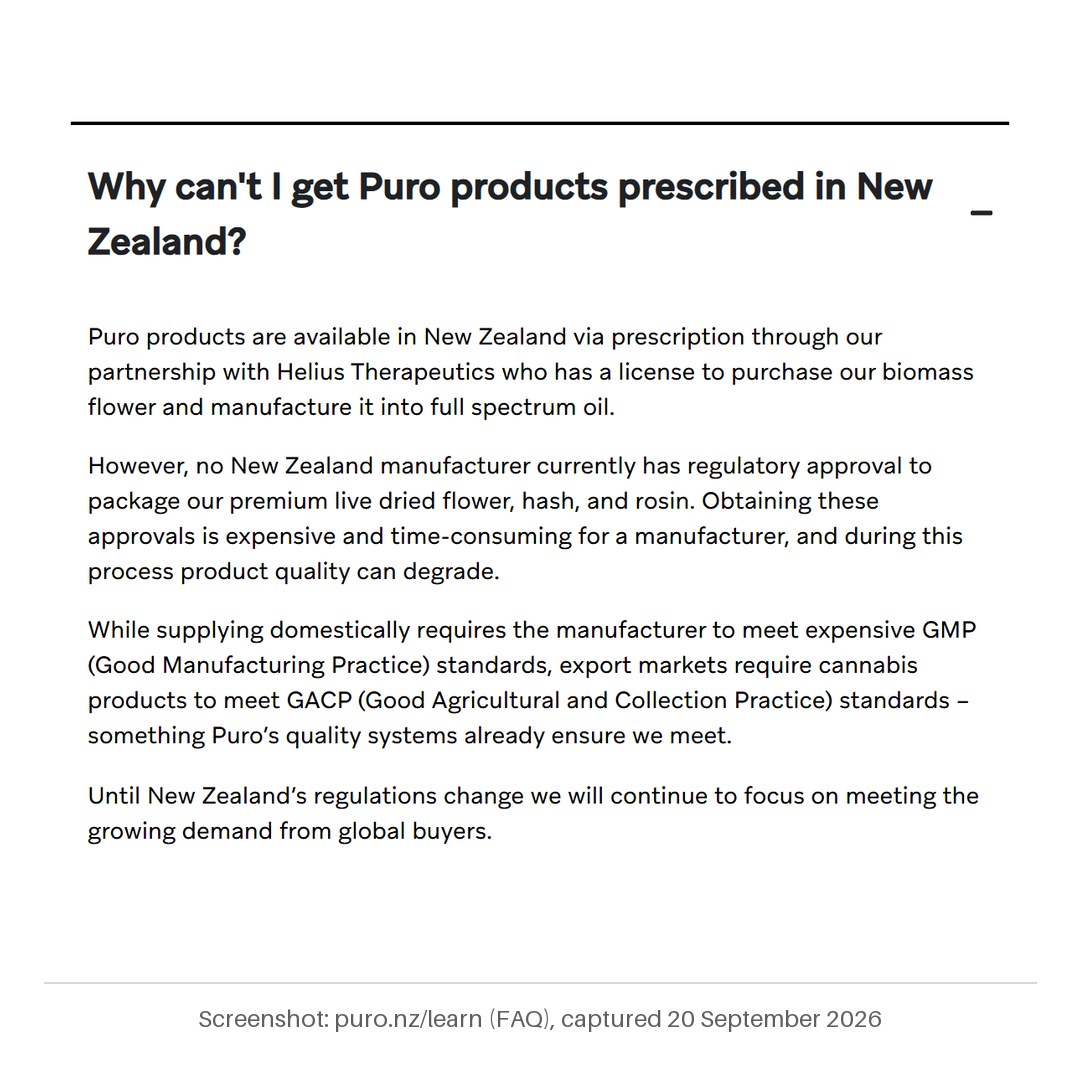
In their own words, from the FAQ on Puro's website (as at 20 September 2026), under "Why can't I get Puro products prescribed in New Zealand?":
However, no New Zealand manufacturer currently has regulatory approval to package our premium live dried flower, hash, and rosin. Obtaining these approvals is expensive and time-consuming for a manufacturer, and during this process product quality can degrade. While supplying domestically requires the manufacturer to meet expensive GMP (Good Manufacturing Practice) standards, export markets require cannabis products to meet GACP (Good Agricultural and Collection Practice) standards – something Puro's quality systems already ensure we meet. Until New Zealand's regulations change we will continue to focus on meeting the growing demand from global buyers.
And in the media:
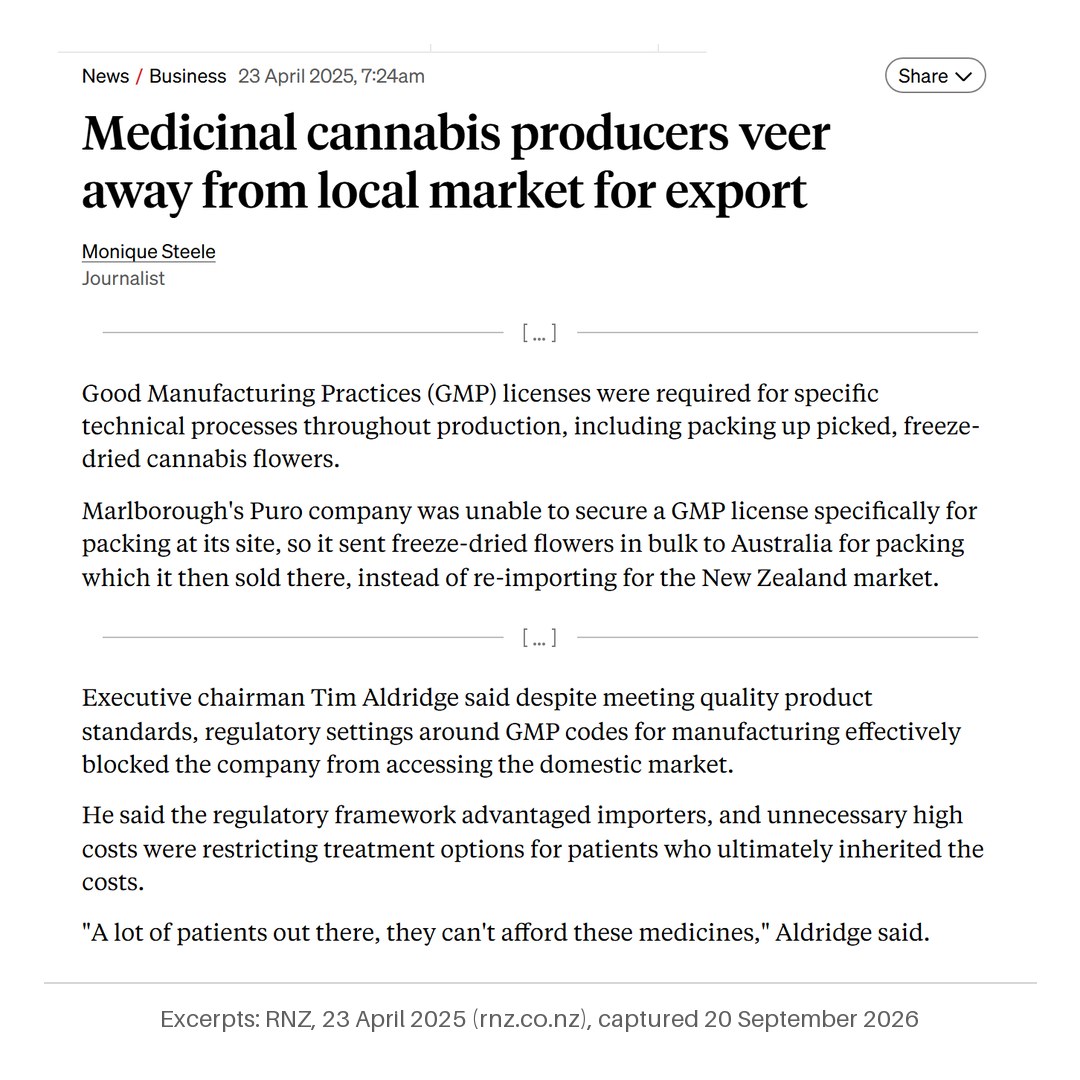
- RNZ, 23 April 2025, Medicinal cannabis producers veer away from local market for export: executive chairman Tim Aldridge said regulatory settings around GMP "effectively blocked" Puro from the domestic market and that the framework advantaged importers. The article reports Puro couldn't secure a GMP licence for packing at its own site, so it sent freeze-dried flower to Australia for packing and sold it there rather than re-importing it.
- RNZ The Detail, 7 July 2025, Rules and red tape holding back cannabis industry: Aldridge: "So we would have to send our product to Australia to be packaged and then once they're in Australia we would bring them back in but the time and cost of doing that is just economically prohibitive."
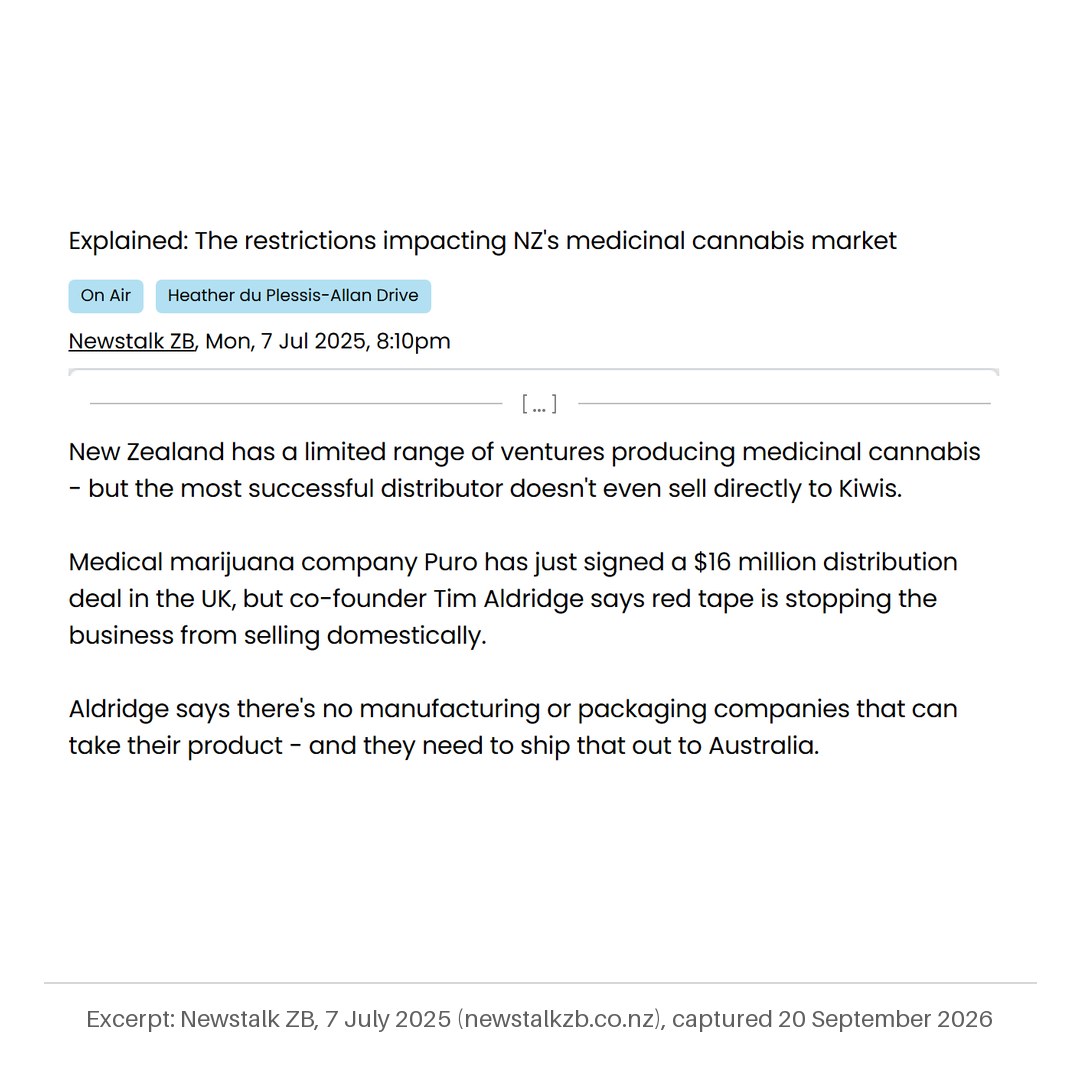
- Newstalk ZB, 7 July 2025, Explained: The restrictions impacting NZ's medicinal cannabis market (Heather du Plessis-Allan Drive): the segment summary says co-founder Tim Aldridge "says red tape is stopping the business from selling domestically" and that "there's no manufacturing or packaging companies that can take their product - and they need to ship that out to Australia."
- Otago Daily Times, 3 September 2026, New Zealand's largest medicinal cannabis exporter takes home two of the industry's top honours: same story; 92% of the medicinal cannabis leaving NZ, ingredients in 50 Australian products, UK flower launched, Germany next.
All of those comments seem pretty rough, like there's no way forward, but again I would contest that's not the case. Let's look at their three main points of contention, and if we can debunk those, then I think we'll be able to make a pretty strong case for now being a perfectly acceptable time to get into cultivation.
- Nobody in NZ can pack/process their flower
- GMP makes domestic supply uneconomic
- The only option is to export until things change
Claim 1: "No New Zealand manufacturer can take our product"
This is the primary issue that's been talked about again and again. In order to understand their position, it helps to know a little about the NZMQS (New Zealand Minimum Quality Standards).
You see, the Govt set up the scheme following feedback from industry players, such that they require a product to be registered as meeting the NZMQS. Those standards are made to protect patients from even the most basic of issues, like heavy metal contamination, mold and bacteria, pesticide contamination and more.
These same rules basically require that you have 3x batches go through the process of getting dried in a GMP-certified (by Medsafe) facility, packed into the applicable containers, representative samples taken and lab-results obtained, then finally submitted alongside stability data.
A couple of other points of note, to explain some of the nuance of NZ's scheme:
- Australia has mostly the same regulations following the European Pharmacopoeia just as we do, however they're a little looser because there's not a mandatory product registration. You can, but it's historically been an "honesty" system. Only ~20 products in Australia out of their 2000-odd have been through registration like our product has under NZMQS.
- Australia are also a little stricter with their microbial limits, so if flower meets specifications for Australia then it should do so in NZ too.
- The GMP certification must be done by Medsafe if the facility is within NZ. They won't recognise 3rd-party therapeutic GMP certification. That's OK, it's only ~$20k for the certification, and when you're doing millions and millions in export-revenue it's not so bad.
- The stability data that must be submitted alongside a product registration basically proves that by the time the patient gets to the end of the stated shelf life, say 6 months, that their flower will still be within +/- 20% of the active ingredient amounts on the label. If you ordered a 15% THC product, it'll still be 12% or closer by the time you reach the expiry date.
Now armed with this knowledge about how the scheme works, you may also wonder how Chill Division have taken flower that was grown at Pause Labs, and had it verified? You don't actually need to have GMP certification as the cultivator. You don't need GACP certification either.
The GMP process only needs to begin from the drying phase, prior to packing, but it can be after the cultivation (and after a field-dry to make the product safer for transport too). Chill Division conducted a large amount of PD/PV (Process Development / Process Validation) with Helius to verify the process of receiving flower from a 3rd party (Pause Labs) and ensuring the product still met specifications. This PD/PV proves that if we partially dry the product at a location, take it to Helius, finish the drying there, that the product meets the requirements of the NZMQS.
We know this can be done because we received confirmation from the Medicinal Cannabis Agency in December that we met the requirements, and they added the product to our license as allowed for sale/distribution.
Back to Puro who are saying that there's no manufacturer who can take their product... There's two solutions here:
- Obtain GMP certification, conduct the necessary PD/PV around drying/packaging
- Have a 3rd-party manufacturer use their facility for the packaging as we have.
But hold up a moment, they said nobody can take it? But how can these manufacturers take yours from Pause Labs?
Well, it may be that there isn't any stability data for their potency. Most manufacturers have brackets of stability data proving that X jars are safe with Y percentage of their active ingredient. For example, 15% -> 25% THC. That however doesn't take into account any CBD active ingredients, so if somebody had a flower that was 10% CBD and 5% THC, that doesn't fall within the bracketed stability data.
Or it may have been that all their flower is incredibly high potency and falls outside of that bracket, for example 28% THC. That could still be registered as a 25% for example, or, they can conduct the necessary PD/PV to get the stability data for that 28% cultivar.
It's not just Helius that can do this either! There's a few places that have GMP certification:
- Eqalis: Also have multiple flower products at multiple potency levels.
- Helius (now owned by Ora Pharm): Already were purchasing CBD biomass for extraction, so there's a commercial relationship already there.
- ZHM (Health House): Had a "balanced" THC/CBD flower product and went through the entire process as well of getting stability data for that product.
- NUBU: Predominantly importers, they also export flower from Kalyx to Australia for processing/packaging by ECS Botanics, before being brought back to NZ. They have a facility in Auckland that was certified earlier this year too.
That last one directly also contradicts Puro's claims about it being impossible to bring back, when that's what NUBU have been doing for 3-4 years now.
Granted, "fresh is best", however there's nothing stopping the exporting and reimporting. This is why we have the requirements of 3x batches worth of data be submitted alongside the product registration data to the Medicinal Cannabis Agency. Those three batches worth of data show you've got a process and over multiple iterations those processes work. The testing only takes place on the finished and jar'd up or bagged product, so it's not going to miss out on any part of that earlier international shipping process.
Claim 2: "GMP makes it uneconomic"
GMP definitely costs more. That's part of why it was pushed for when the legislation was being written, to ensure that cowboys don't skimp on even the basics.
All that a grower needs is their Cultivation activity on a Medicinal Cannabis License. That's ~$6k P.A. It's nothing. With that license comes effectively zero limits to how much you can cultivate at the licensed location.
In addition, all other products that are currently verified and on the market are all packed / manufactured in a GMP facility. Both the domestic products from Helius / Cannasouth (Eqalis), as well as products that NUBU have exported / reimported (Now from Kalyx and OGG), and all the internationally imported products such as those from Tilray, Aurora or Medleaf.
If it were truly uneconomical, do we think all those other companies would still be doing it? Bleeding money per-jar? Or would they have bailed? Because none of the companies actually selling here are blaming GMP.
But "the framework advantages importers", Puro say. Well, initially yes. Other countries had Medicinal Cannabis frameworks well ahead of NZ. They had time, opportunity and resources to start up those facilities, get them certified in the countries we have a GMP-equivalency partnership with, and get stability data. However, all of the aforementioned four companies have that now. The international advantage in that aspect is gone, replaced only with a lower cost-of-production for goods. But the cost of production isn't the issue, given Puro are currently exporting and making ends meet in Australia, just as a number of the other aforementioned companies are.
It just makes no sense and reeks of excuses to throw out to garner sympathy from people who don't know any better about how to call out the misinformation from Puro.
Claim 3: The only option is to export
This may be the easiest to debunk. There are a large number of options we've looked at already:
- Get GMP themselves
- Get a 3rd-party domestic GMP packager to do it
- Use the same packager in Australia to get the product ready for NZMQS verification in NZ.
Now there's going to be a cost no matter which way is involved, but the cost isn't insurmountable if I've been able to do it as Chill Division, a one-man band. We took flower from Pause Labs, NZ's smallest cultivation facility (~19sqm) and brought it to market using Option 2.
Sure, exporting to Australia is easier because you don't have to go through product registration. But it's not the only option. It's an option for sure, and a great option to have, but far from the only option.
What it looks like when you just do it
Chill Division started the process initially in April 2024 with Helius. I'm involved in both companies, Pause Labs (the grower) and Chill Division (the distributor), which helps, but it's the same as if someone were taking their own product through verification. In this instance though, Chill Division was simply buying the "wet" flower from Pause Labs (still stem-on), rather than growing it under that company name. Chill Division paid for all the PD/PV, and Pause Labs had the difficult task of growing it all within spec while we ensured the processes were suitable.
By December 2025, we had received confirmation of NZMQS verification from the Agency and were free to distribute it. Due to timing, Christmas etc, we had a number of harvests in "Bulk hold", so after they're dried and cured they were held prior to packaging. Again, all permissible within the GMP framework, and that data was included alongside our product registration submission.
The product was packed in January, and by February we were in a number of pharmacies / clinics, ready to be prescribed and dispensed. We're now gearing up for a second product registration this month of flower from Pause Labs, and another from Forte Farms next month. Both of these should take approx 6 months to get registered, rather than having to conduct the full suite of PD/PV all over again each time.
So if the smallest cultivator in the country (Me, as Pause Labs) and a one-man band regulatory consultant / distribution company can get NZ-grown flower to NZ patients under those same regulations... why can't the country's biggest grower, who's pulling in millions of dollars of exports? Puro say it's impossible, the only option is to export, or GMP makes it uneconomical, but we have a number of examples of companies big and small that are all doing it.
So perhaps it's time we collectively call out that nonsense. It's not helpful. They need to take responsibility for their own actions (or, lack thereof) instead of blaming regulations, and spoiling the narrative for everyone else.
What Puro could do to get to market domestically
- Pick a GMP manufacturing partner from the list above
- Provide three batches (at 10% the size of a production batch) to run through the process. A batch doesn't have to be a whole harvest, it could be a row of 100 plants for example.
- Optionally, work with their GMP manufacturing partner above to get stability data if none is suitable, for example a CBD-dominant cultivar or an extremely high/low potency THC flower.
- Submit the paperwork for NZMQS product registration
...and that's it?
Six months later (Well, it could be 4-12 months depending on how well-done the paperwork was), product registration comes through, and they're ready to sell domestically.
Selling to NZ patients, at NZ prices, with fresh flower that has (or maybe hasn't) had to leave the country. If they want to be the "Zespri of medicinal cannabis", it's a bit of a hollow ambition if Kiwis can't get their flower. But it's not the regulations' fault.
So, is now a good time?
One of the things I always make a point of advising people I'm working with and consulting for, is not to make them any promises on returns, revenue, yields etc. What one cultivator can do, another may really struggle with, or another may be able to far exceed.
Wholesale pricing for flower domestically is approx $1.50 -> $3.50 per-gram for the most part. Chill Division pays Pause Labs well above that, because I want to encourage more craft, boutique, artisanal flower, and so as the supply/distributor my margins are slim but still viable. That's without the cost-savings you'd get with scale too.
So yes, the regulations are strict, but not impossible. You can navigate them, the path to NZ patients is proven. Don't let the biggest voice in the room talk you out of entering the market, especially not domestically.
But provided somebody goes into it with the intent of actually making it happen, rather than making excuses, it's achievable. And it's time we all moved on from the tired and factually false narrative that it isn't possible.
If you want to start a cultivation company, we'd love to help you get licensed, or if you're already licensed we'd love to help you navigate the product registration pathway.
Book a free call with us to see if we can help you here: Contact us.